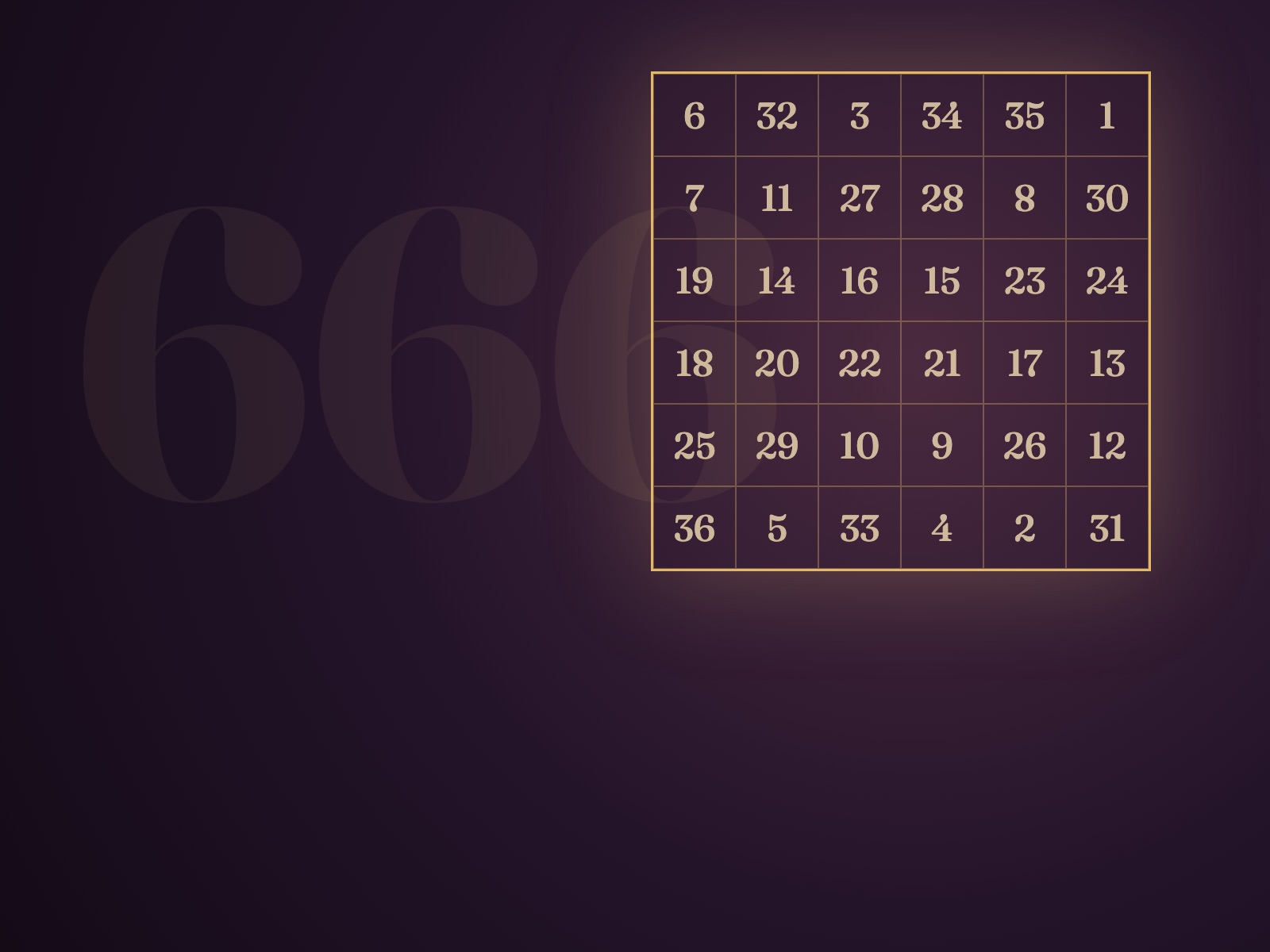
A small grid, six cells by six, fascinated Renaissance scholars and unsettled more than one reader. Add up all its numbers: 666. It is neither chance nor a hidden message, but a simple mathematical fact that tradition filled with meaning.
A grid of 36 numbers
In 1533, Heinrich Cornelius Agrippa published seven magic squares in the second book of his Occult Philosophy, one for each of the seven heavenly bodies visible to the naked eye. The square of the Sun is six cells wide. It holds every number from 1 to 36, each exactly once. Every row, every column and both long diagonals add up to the same total: 111.
| 6 | 32 | 3 | 34 | 35 | 1 | 111 |
| 7 | 11 | 27 | 28 | 8 | 30 | 111 |
| 19 | 14 | 16 | 15 | 23 | 24 | 111 |
| 18 | 20 | 22 | 21 | 17 | 13 | 111 |
| 25 | 29 | 10 | 9 | 26 | 12 | 111 |
| 36 | 5 | 33 | 4 | 2 | 31 | 111 |
Where does 666 come from?
Add 1 + 2 + 3 + … + 36. There is a shortcut known since Antiquity: multiply the last number by the next one and divide by two. 36 × 37 ÷ 2 = 666. And since the square has six rows of 111, we get 6 × 111 = 666 again.
In other words, any 6×6 magic square using the numbers 1 to 36 totals 666. Agrippa did not invent it; he noticed it and wrote it down, listing for each planet its own "numbers". For the Sun: 6, 36, 111 and 666.
Why this number worried people
A Christian reader in 1533 knew another 666: the "number of the Beast" in the Book of Revelation (chapter 13). Finding it at the heart of the square of the Sun, the planet of light, was unsettling. The simplest explanation is mathematical: 666 is the sum of the first 36 numbers, and it appears wherever you add 1 to 36.
The hardest of the seven
Of the seven squares, the Sun's is the trickiest to build. Odd-sized squares (3, 5, 7, 9) fill up with a simple staircase method. Squares whose side is a multiple of 4 (4, 8) have their own trick. Six fits neither family and needs a construction of its own.
The Sun in tradition
In the tradition that goes with these tables, the Sun belongs to Sunday, to gold and to the idea of radiance: self-confidence, being seen, taking your place. These are traditional correspondences, tools for reflection, not formulas that act on their own.
The seven squares at a glance
| Planet | Side | Magic sum | Total |
|---|---|---|---|
| Saturn | 3 | 15 | 45 |
| Jupiter | 4 | 34 | 136 |
| Mars | 5 | 65 | 325 |
| Sun | 6 | 111 | 666 |
| Venus | 7 | 175 | 1,225 |
| Mercury | 8 | 260 | 2,080 |
| Moon | 9 | 369 | 3,321 |
The smallest square belongs to Saturn, the planet that seemed slowest; the largest to the Moon, the fastest. To read the seven squares as a daily oracle, see The 7 tables of destiny.
For entertainment and self-reflection.
Frequently asked questions
Why does the square of the Sun add up to 666?
Because it holds every number from 1 to 36, and 1 + 2 + … + 36 = 666 (36 × 37 ÷ 2). Each of its 6 rows makes 111, and 6 × 111 = 666.
Who published the square of the Sun?
Heinrich Cornelius Agrippa, in the second book of his Occult Philosophy, in 1533. He gives seven squares, one for each of the seven heavenly bodies visible to the naked eye.
Is the square's 666 linked to the Book of Revelation?
It is the same number as the "number of the Beast" in Revelation 13, which troubled many readers. But it simply comes from adding the first 36 numbers.
On which day is the square of the Sun read?
In tradition, on Sunday, the Sun's day, or during an hour of the Sun. It is a tool for reflection, not a formula that acts on its own.