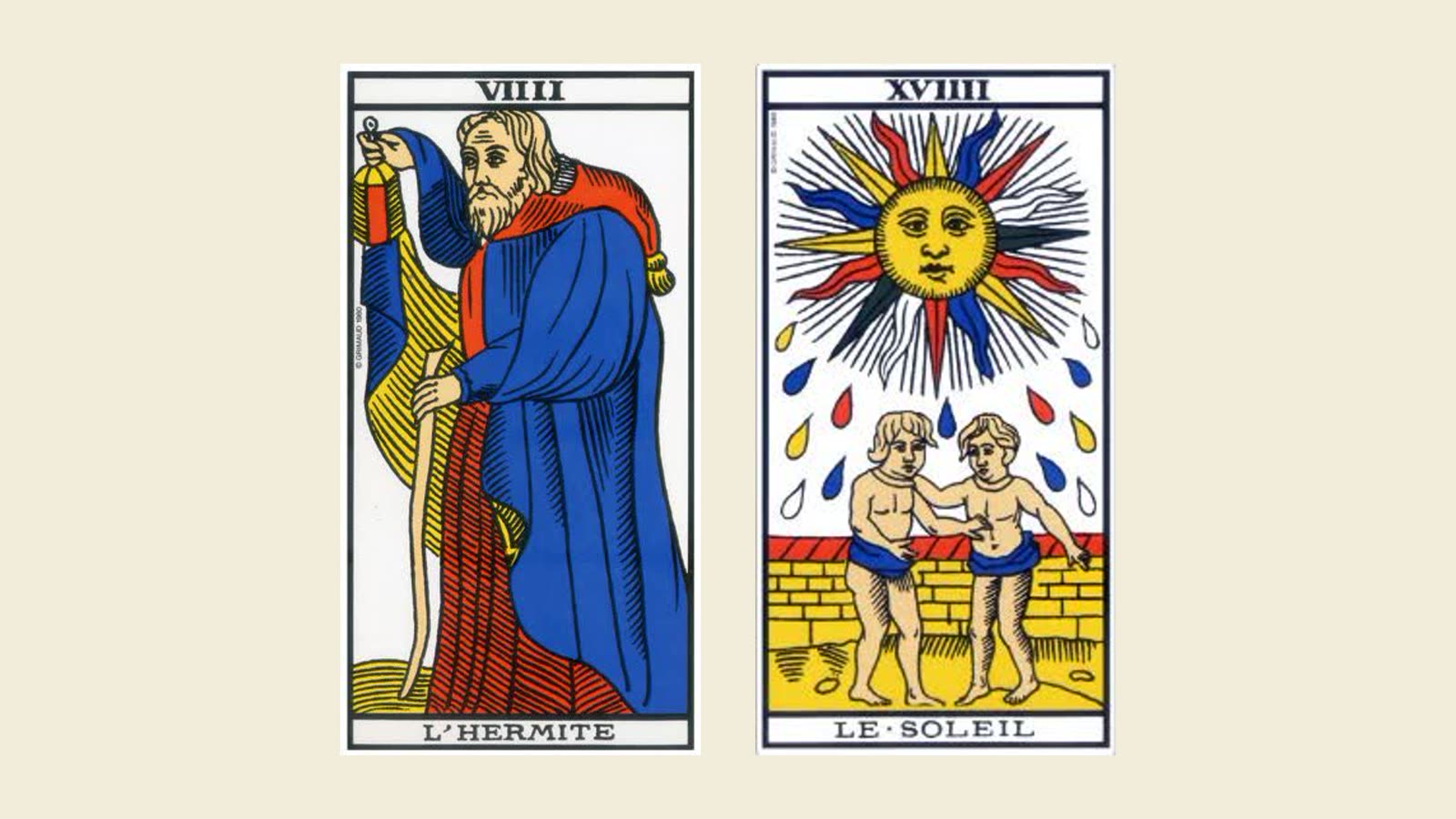
Your birth name resonates like a vibrating power. It has been used in many traditions over the centuries. It is the main support of numerology.
Antoine de Saint-Christophe
Nomen est omen. The name is an omen. The phrase is Latin, it is already found in Plautus, and the Romans took it seriously: Cicero reports that when soldiers were levied and censuses taken, care was taken to call first the men whose names were of good omen.
Antoine put it at the head of several chapters of his manual. And he extended it far beyond first names.
The name is an omen… but so is the place, like any vibration, like a colour, a sound, a taste, a scent.
Antoine de Saint-Christophe
A person's name, a place name, the name of a plant, the name of an object: for him, all of them carry a vibration. And that vibration can be calculated.
Words that can be counted
The principle is that of gematria, the very old art of giving each letter a numerical value. In Hebrew as in ancient Greek, letters also served as numerals: so every word naturally had a number. Kabbalists made it a science of correspondences: two words of the same value are secretly linked.
Antoine used several methods, depending on what he was looking for.
- The grid of the Kabbalah, with its units, tens and hundreds, to place your first name on one of the 360 degrees of the zodiac.
- The method of numerical equivalences of the Kabbalist Georges Lahy, to find the word hidden behind a number.
- The wheel of Pythagoras, to link a name to the major cards of the tarot.
The example of the Commodore
Antoine liked to show the method on the name of his most famous machine, the Commodore.
The word comes from the title of commander: originally, the man who ran a commandery, one of those houses of the religious and military orders that, in the Middle Ages, kept their property and their secrets.
First reading: the number of letters
C.O.M.M.O.D.O.R.E. has nine letters. And for Antoine, 9 is the digit of magical fulfilment. He drew a rule from it: any ritual, whatever it may be, performed nine times in a row, is permanently recorded in the collective memory.
Second reading: Georges Lahy's equivalences
| C | O | M | M | O | D | O | R | E |
|---|---|---|---|---|---|---|---|---|
| 3 | 60 | 40 | 40 | 60 | 4 | 60 | 90 | 5 |
3 + 60 + 40 + 40 + 60 + 4 + 60 + 90 + 5 = 362. And in Lahy's table, 362 is also the value of the French word ragaillardir, “to revive, to put new heart into”.
Let's reduce: 3 + 6 + 2 = 11. The eleventh card of the Marseille tarot: Strength, which tradition calls the law of absolute action.
Third reading: the wheel of Pythagoras
| C | O | M | M | O | D | O | R | E |
|---|---|---|---|---|---|---|---|---|
| 4 | 8 | 19 | 19 | 8 | 5 | 8 | 11 | 3 |
4 + 8 + 19 + 19 + 8 + 5 + 8 + 11 + 3 = 85. Then 8 + 5 = 13. The thirteenth card: the Nameless Arcanum, the law of transformation.
Antoine gathered the three readings into a single sentence:
Commodore = complete (strength) change (transformation).
Antoine de Saint-Christophe
Nine letters for fulfilment, Strength for action, the Nameless Arcanum for transformation. The name, he said, had been well chosen.
Your life line
The same principle applies to everyone. Antoine called it the life line: your surname, your first name and your year of birth, translated by the wheel of Pythagoras into major cards of the Marseille tarot.
You get four cards:
- the card of your personality;
- the card of your evolution;
- the card of the goals to reach;
- the card of reflection.
And a fifth, the sum of the first four, which stands for the outcome of the whole.
Each card is a law
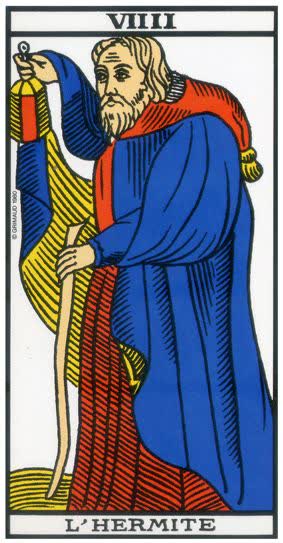
For Antoine, the arcana are not pictures to interpret freely. They are laws. He gave the example of a life line made up of the Hermit, the Tower, the Chariot and the Hanged Man:
| Card | Law |
|---|---|
| The Hermit | The law of knowledge |
| The Tower (La Maison Dieu) | The law of the balance of opposites |
| The Chariot | The law of responsibility |
| The Hanged Man | The law of compensation |
Knowing your cards means knowing the laws that govern your life. And knowing which ones to respect first. Antoine added that this life line can be “marked” up to the fourth octave.
The two-tarot spread
Antoine also taught a way of seeing, in the cards, whether luck has set you a meeting. It uses your life line, and does not need your time of birth.
- Get two Marseille tarot decks, and remove the minor arcana to keep only the 22 major ones.
- From the first deck, lay out 12 arcana in a row, chosen as you like, and set the other 10 aside.
- A card that comes out upright: the matching law is working in your favour. A card that comes out reversed: a law has not been respected.
- From the second deck, choose 12 arcana again and lay them out below the first ones.
The sign to watch for: if, in the second row, two identical arcana belonging to your life line repeat, luck is there to meet you. Antoine wrote that in his experience this sign had never let him down: for him, it pointed to a favourable moment. And if the repetition happens in the seventh position, tradition reads it as the sign of a meeting. A reading from tradition, for entertainment and self-reflection: it guarantees no result.
The three families of cards
Antoine sorted the 22 arcana by the luck they carry:
| Family | Arcana |
|---|---|
| Major luck | The World, the Chariot, the Wheel of Fortune, the Magician, Justice, the Emperor, Strength, the Empress |
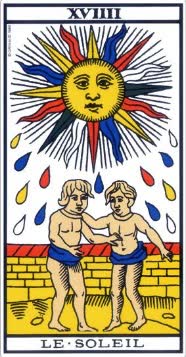
| Minor luck | The Sun, Temperance, the Star, the Popess, the Hermit, the Lover, the Pope |
| To watch | The Hanged Man, the Nameless Arcanum, the Tower, Judgement, the Fool, the Devil, the Moon |
First names that bring luck
Antoine also watched the omen of first names in everyday life. He told the story of a woman for whom every man whose first name began with C had always brought luck. Like that Camille, from Ciney, who drove his Citroën with his little dog César, and who brought her keys back to her at the Carré d'As café, in Charleroi.
He called these coincidences zones of synchronicity: certain letters, certain numbers, certain places seem to follow us all our lives. All you need to do, he said, is look at your past to recognise them.
And he drew a precise rule from it for one of the places in his catalogue, the chapel of Mohiville: you get everything faster there if the person who drives you has a first name beginning with certain letters. Read: Mohiville, the chapel where you get everything.
Places and plants too
The omen of the name doesn't stop at people. In words, Antoine heard what tradition calls the language of the birds, a play on sounds that only works in French.
- In verveine (verbena), he heard vers la veine, “towards luck”. Read: verbena
- In Pierpont, the family whose grave strengthens the rite of the Mont des Géants, he heard pierre (stone) and pont (bridge). Read: the Mont des Géants
- In Thorn, the little white town, he heard Thor. Read: Thorn
- And in places whose names end in “-ville”, which once meant “stage” on a journey, he saw places where you never travel alone.
There is no such thing as chance.
Esoteric saying quoted by Antoine
Send the workshop your surname, your first name and your year of birth: we calculate your life line and tell you which laws govern your luck.
For you
The omen of your name
Your astrologer reads your name and first names, and tells you how to bring them into line with your plans. The reply comes in writing.
€18
In the workshop: the Commodore, the machine whose name reduces to the digit of fulfilment →
For entertainment and self-reflection.
Frequently asked questions
What does “Nomen est omen” mean?
“The name is an omen.” The Latin phrase sums up Antoine's idea: names, first names and words carry a number, and that number says something.
What is the life line?
Your surname, your first name and your year of birth translated, by the wheel of Pythagoras, into major cards of the Marseille tarot. You get four cards, which for Antoine are laws.
Do I need my time of birth for the two-tarot spread?
No. The spread uses your life line and two Marseille tarot decks, without the time of birth.
Free guide · Luck
Stack the Odds in Your Favor. Feel like it always lands on you? No, you're not cursed. A bad patch has a shape, and a calendar to get out of it. Twenty pages, free, by email.
Get the free guide