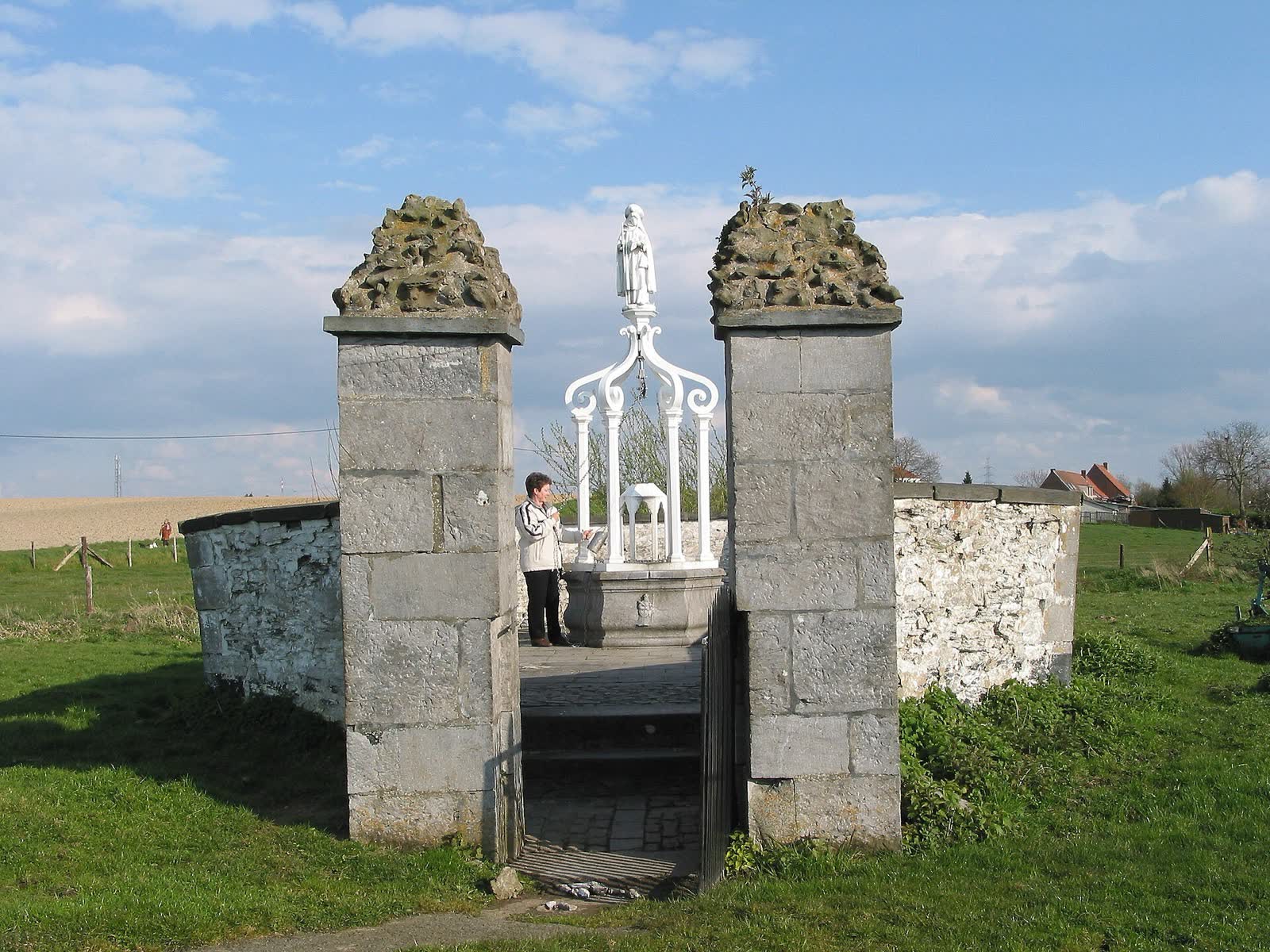
The water of the Saintes well is the strongest vibration in Belgium.
Words of a medium, reported by Antoine
Saintes is a village in the municipality of Tubize, at the far west of Walloon Brabant, where Wallonia meets Flanders, about 25 km south-west of Brussels. A quiet village, a big church, a square. And close by, a well pilgrims have known for more than a thousand years.
For Antoine, it was one of the great places of Belgium. He devoted entry 2-590003 to it, one of the longest in his catalogue.
The saint with the rake
Saint Renelde had a fine pedigree. Tradition makes her the sister of Saint Gudula, patron saint of Brussels, and the cousin of Saint Gertrude of Nivelles.
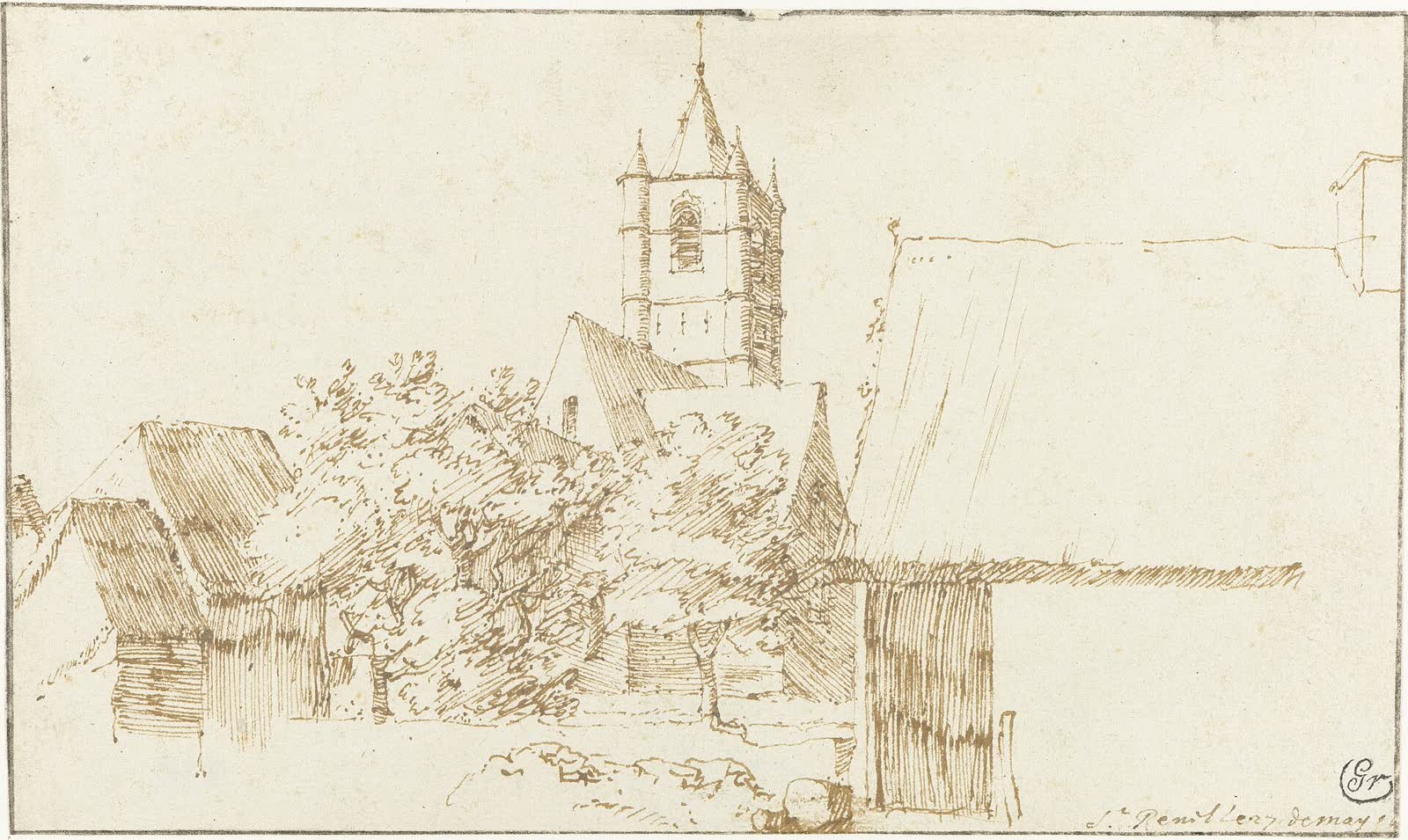
She is shown in pilgrim's dress, with the scallop shell and the staff. But the story told about her in Saintes is that of a woman who worked in the fields like everyone else.
One year, the drought was terrible. Water ran out across the whole parish, and people suffered greatly. So Renelde struck the ground with her rake. And water sprang up.
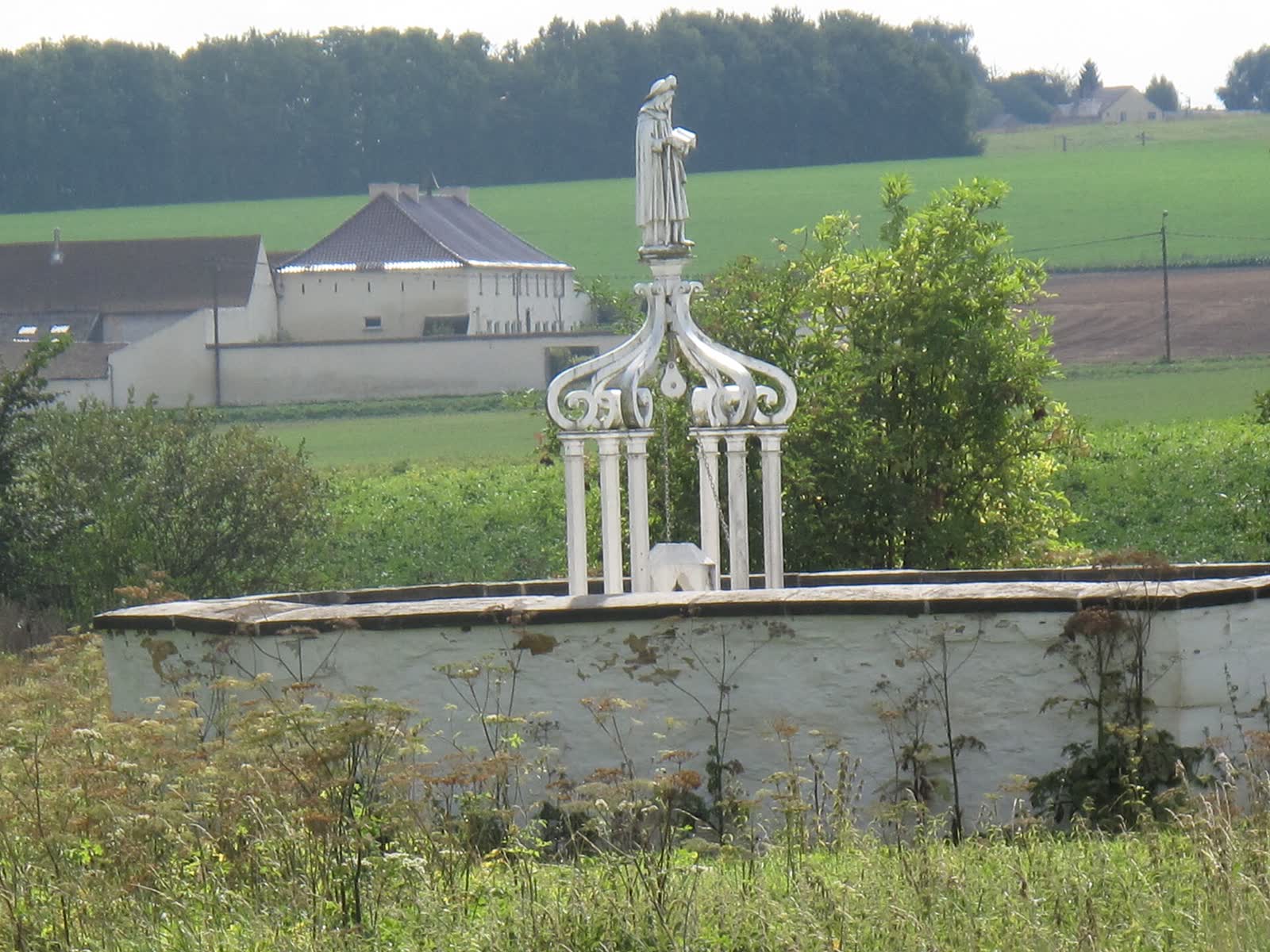
The saint is said to have been beheaded later, along with two companions, Grimoald and Gondulf. Tradition holds that their relics passed their powers on to the waters of the well. Her statue now stands above the spring, and every year, on Trinity Sunday, the relics of the holy trio are carried in procession on a cart.
Three saints, a Trinity procession: in Saintes, everything speaks of the number three. And so does Antoine's rite.
The esoteric rite of the well
Here is the rite, as Antoine passed it on.
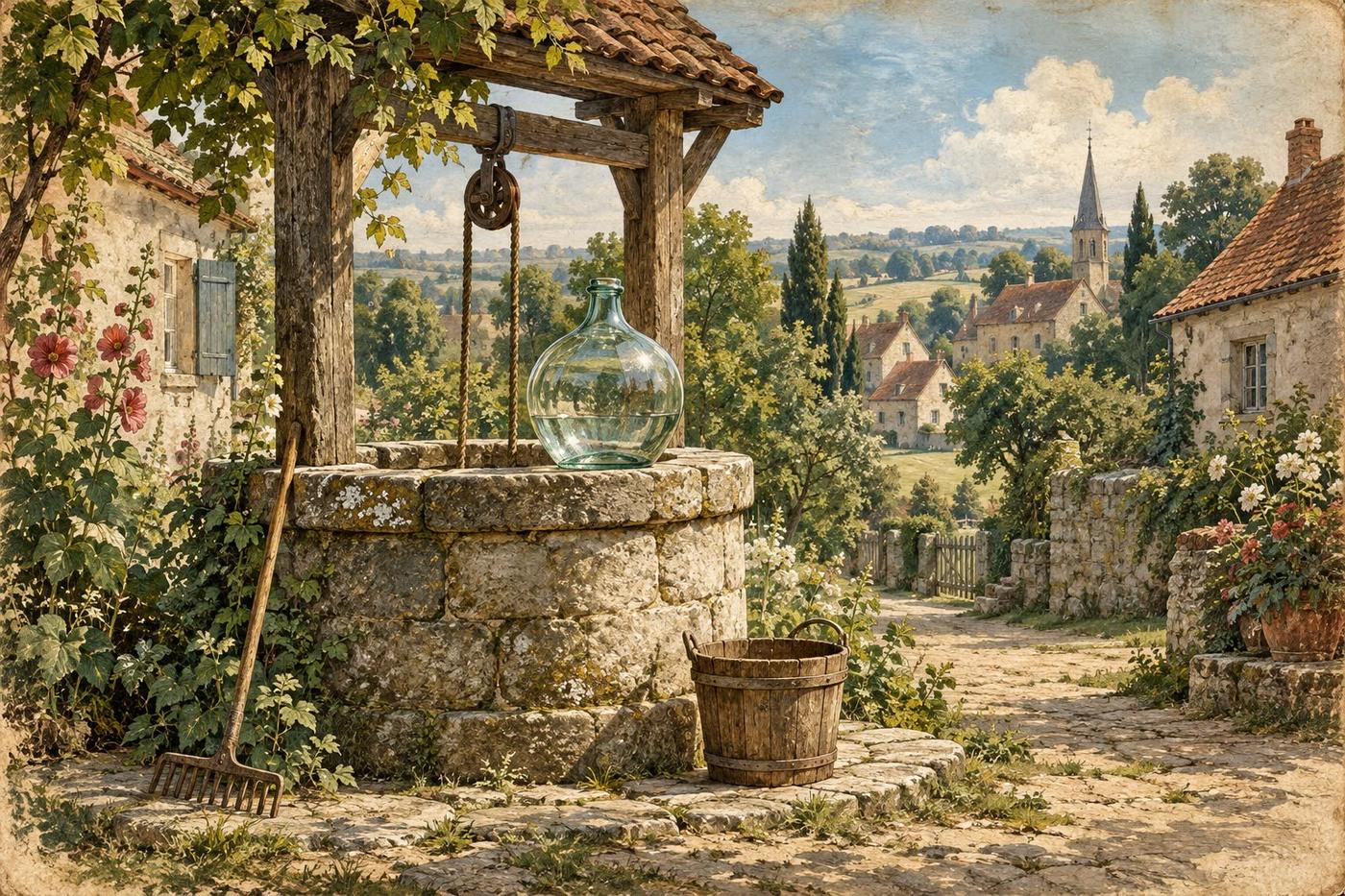
What you need: a Holy Trinity medal, and a clear demijohn with a wide neck.
- Wear the Holy Trinity medal around your neck.
- Draw three litres of water from the well.
- Pour the three litres into your clear demijohn right there, on the spot: this is essential.
- Back home, place the demijohn at the foot of your bed.
- Drop the medal into the precious, mysterious water.
And then? Saint Renelde takes care of the rest.
Because the Saintes well, Antoine wrote, is bound up entirely with the mystery of the Holy Trinity.
To give thanks
If your grace is granted, Antoine recommended two gestures of thanks:
- Go and touch the old hearse kept inside the church of Saintes.
- Make the Holy Trinity pilgrimage, in Saintes.
If nothing happens: the Montaigu "reset"
Antoine had planned for the case where nothing moves. After nine weeks with no result, you go and walk three times around the altar of the basilica of Montaigu, Scherpenheuvel in Dutch, Belgium's largest Marian pilgrimage site, in Flemish Brabant.
It is, he said, a kind of "reset", a return to zero. After which you go back to Saintes and draw three new litres.
The trout-skin rite
Antoine linked to the Saintes well an even older rite, which he said came from the tradition of Otto Brock and from a little book by Yves Brunel, Magie de la truite ("The Magic of the Trout"), published in 1962.
You simply lay, for a few moments, directly on the skin of your chest, a very fresh trout skin from a region close to a major cosmo-magnetic site: the commandery of Fourons-Saint-Pierre (Sint-Pieters-Voeren), the Saintes well, the sarcophagus of Arles-sur-Tech. And this, every May 31, the day of the Visitation, to get rid of bad luck for good, as the tradition puts it.
Antoine added that this practice can, among other things, make up for a lack of rain on that day.
May 31 is also the day of Maggy and Renée, the two young women people entrust with love and money. Read their story.
The demijohn and the living water
In the old tradition Antoine reported, people did not always stop at the medal. Until the Second World War, they put young trout from the nearby river into the demijohn filled with well water. Antoine linked this custom to an old ritual meant, according to tradition, to drive what were called "harmful waves" out of a home, similar to the Teutonic rite and the rite of Saints Abdon and Sennen of Arles-sur-Tech.
Later, the trout were replaced by the symbol of the seahorse, the "sea horse". In Mediterranean civilisations, the seahorse has always been a powerful lucky charm: people wear it as an amulet, or simply dried, to tame luck, help children with their lessons and invite prosperity all year round.
How to get there
The Saint-Renelde well and fountain are in Saintes, in the municipality of Tubize, in Walloon Brabant. The church, with the hearse you touch to give thanks, is in the heart of the village.
Remember to bring your clear demijohn: the pouring must be done on the spot.
Antoine's advice
If you can, always take a miniature bottle of verbena with you when you go to a high place.
Antoine de Saint-Christophe
Back to the map of places of luck
Would you like a Holy Trinity medal prepared for the rite, or can't you travel to Saintes? Write to the workshop.
Photo: Jean-Pol Grandmont, CC BY 3.0, via Wikimedia Commons.
Frequently asked questions
Where is the Saint-Renelde well?
In Saintes, in the municipality of Tubize, in Walloon Brabant (Belgium). The church, in the heart of the village, is very close.
What should you bring?
The Holy Trinity medal, to wear around your neck, and a clear demijohn: you pour the three litres of water drawn from the well into it on the spot.
Why the seahorse?
In the old tradition, people put young trout into the demijohn. They were later replaced by the symbol of the seahorse, a lucky charm of Mediterranean civilisations.