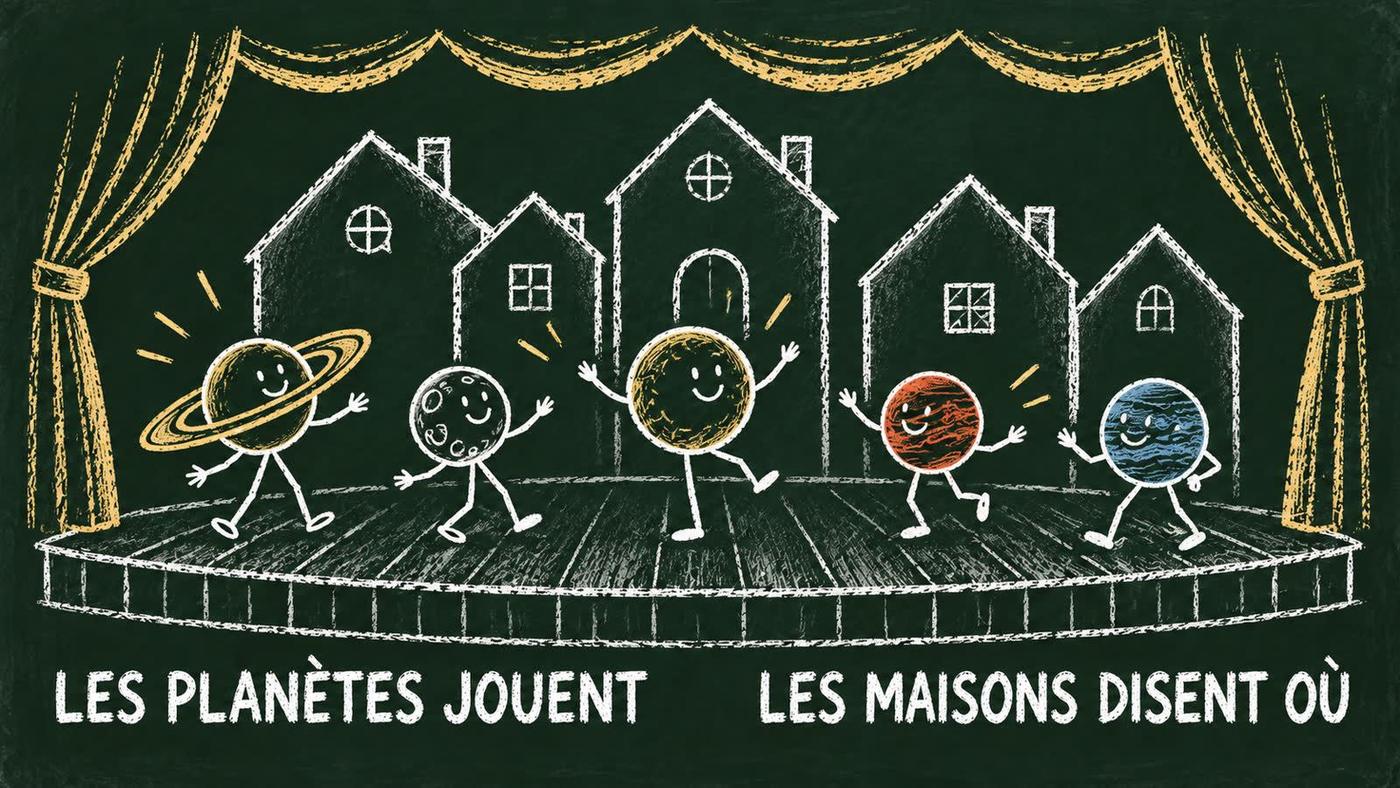
Picture a play.
The planets are the actors: Venus plays love, Mars the fight, Jupiter abundance, Saturn the trial. The signs are their costumes: the same Venus doesn’t act the same way in Taurus or in Scorpio.
But this play is missing something essential: the set. Where does the scene take place? At the office? At home? On a trip? In a bedroom? In front of a lawyer?
In astrology, the set is the houses. There are twelve, like the hours on a clock face. And they are often what makes someone say: “now you’re really talking about my life”.
Twelve slices of sky
At your birth, the sky visible from your birthplace was cut into twelve sectors, starting from the eastern horizon, the Ascendant. Each sector matches an area of life.
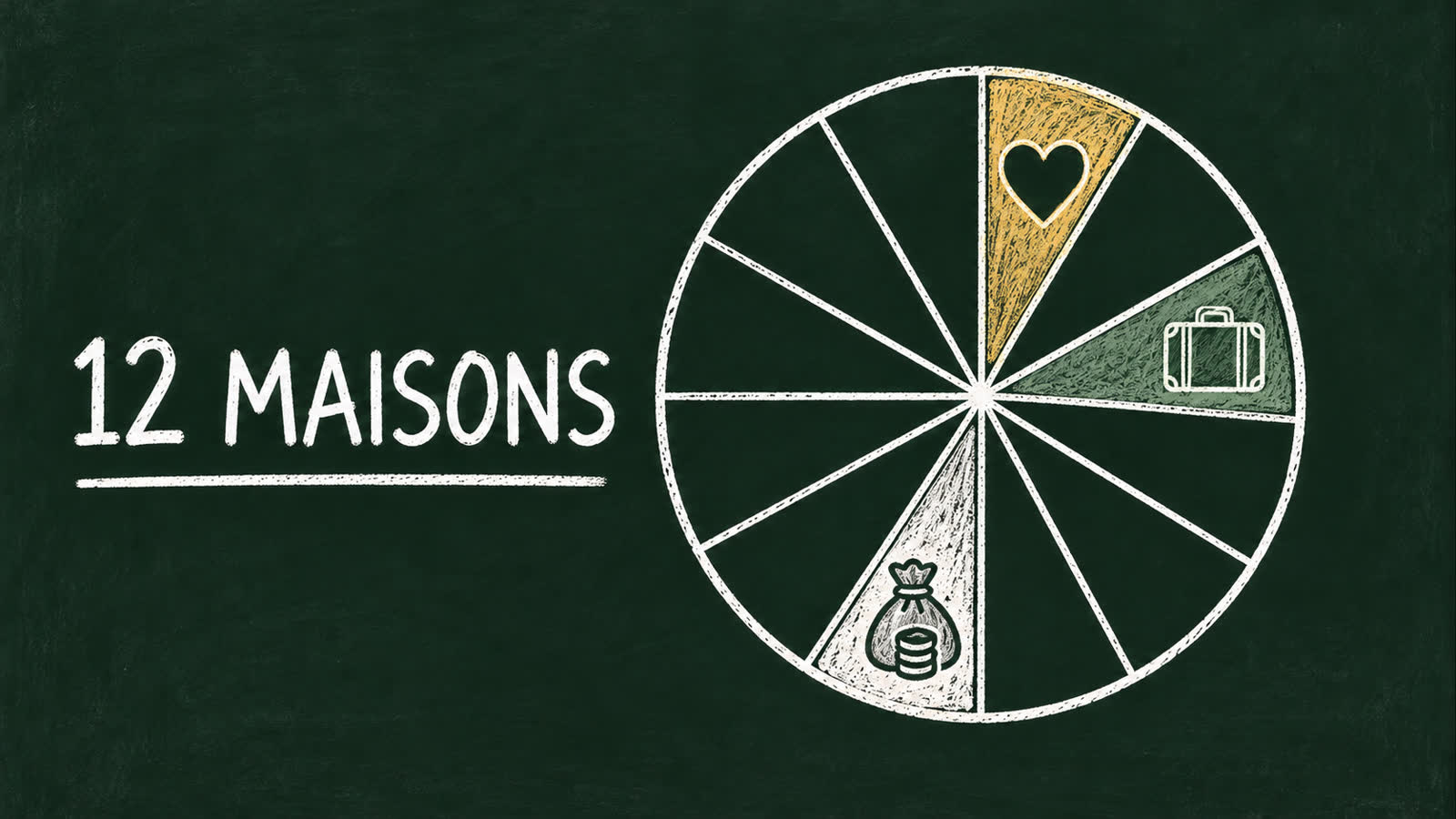
| House | The area |
|---|---|
| 1 | Yourself, your body, your bearing, your beginnings |
| 2 | The money you earn, your possessions, your talents |
| 3 | Exchanges, the people close to you, short trips |
| 4 | Home, family, roots, the later years of life |
| 5 | Love, children, creativity, pleasures |
| 6 | Daily work, habits, everyday routine |
| 7 | Partnership, associates, contracts, open adversaries |
| 8 | Transformations, other people’s money, inheritances |
| 9 | Long journeys, studies, philosophy, foreign countries |
| 10 | Career, reputation, public success |
| 11 | Friends, networks, protectors, hopes |
| 12 | Inner life, withdrawal, what is being prepared behind the scenes |
A planet placed in a house brings its nature into that area. Jupiter in the 10th house: luck comes through career. Venus in the 9th house: love arrives through travel or abroad. Saturn in the 2nd house: money is built slowly, surely.
Full houses and empty houses
It is one of the first things we look at.
In some charts, three, four, five planets pile up in the same house. The whole life then revolves around that area. We have read charts with five planets in the 10th house: people who live for their career, and make no apology for it. Others with four planets in the 4th house: family is the absolute center of gravity.
And the empty houses? They are not “dead”. They simply work more quietly, and their story is read through the planet that rules their sign. An empty 7th house doesn’t mean “no relationship”. It means partnership is not the main subject of the play.
The four angles
Four houses have special status: the 1st, the 4th, the 7th and the 10th. They are the angles of the chart, the four cardinal points of your sky.
- The Ascendant (1st house), in the east: where the sky rises.
- The Imum Coeli, the bottom of the sky (4th house), in the north, beneath your feet.
- The Descendant (7th house), in the west: where the sky sets.
- The Midheaven (10th house), in the south, at the highest point.
A planet on an angle is like an actor in full light, center stage. It marks the whole personality. That is also why astrocartography looks at the places where your planets pass over these angles.
The great debate among astrologers
We owe you a trade secret: astrologers don’t agree on how to divide the houses.
There are several house systems. The best known bear the names of their inventors: Placidus, a 17th-century Italian monk; Regiomontanus, a 15th-century German astronomer; and other older ones, such as equal houses or whole signs.
In France, a great name took part in the debate: Jean-Baptiste Morin de Villefranche, a 17th-century physician and astrologer. According to a famous anecdote, he was present, hidden, at the birth of Louis XIV in 1638, to note the exact moment. His immense Astrologia Gallica defends the Regiomontanus system.
We mainly use Placidus for natal charts and solar returns, because it is the system with which Antoine has the most experience, and we check with other divisions when a planet sits on the border between two houses. That technical detail can change a reading. It is one of the reasons a chart is read, not copied.
The houses of the year
Houses are not only used for the birth chart.
Each year, the chart of your solar return has its own houses. Your Sun for the year falls in one of them, and that is the area that will be in the spotlight for twelve months. That is why the place of your birthday counts: by changing cities, you change the houses, and so the set of the year.
That is the principle of the birthday trip, and it is the most powerful tool we know for steering a year.
Planets say what. Signs say how. Houses say where. A reading that forgets the houses forgets half the story.
A simple exercise
Take the table of the twelve houses above. For each one, write one sentence: how are things going in this area of my life right now?
You will see two or three houses where everything flows, and two or three where things get stuck. When we read a chart, that is often exactly where the strongest, or the most demanding, planets are. And that is where the conversation begins.
For a free, simpler version of this exercise applied to your year, try The Twelve Rooms.
And now, you
Your twelve houses have been waiting for you since your birth. Some are full of light, others quieter, others call for effort. Knowing them means knowing where to put your energy.
If you want your map of the twelve houses, with a reading of each area, the workshop prepares it for you.
Frequently asked questions
What are houses in astrology?
They are the twelve sectors of the sky, divided from the horizon of the birthplace. Each one matches an area of life: money, partnership, career, friends, travel…
What is the difference between signs and houses?
Signs depend on the position of the planets in the zodiac. Houses depend on the exact place and time of birth: they say in which area of life a planet acts.
Do I need my time of birth to know my houses?
Yes. The houses turn with the sky: in two hours, they all change sign.
Which house system should I use?
Several exist: Placidus, Regiomontanus, equal houses, whole signs. Our calculations mainly use Placidus and check planets lying on the border of a house with other systems.
Is an empty house bad?
No. A house without a planet works more quietly. Its story is read through the planet that rules its sign.