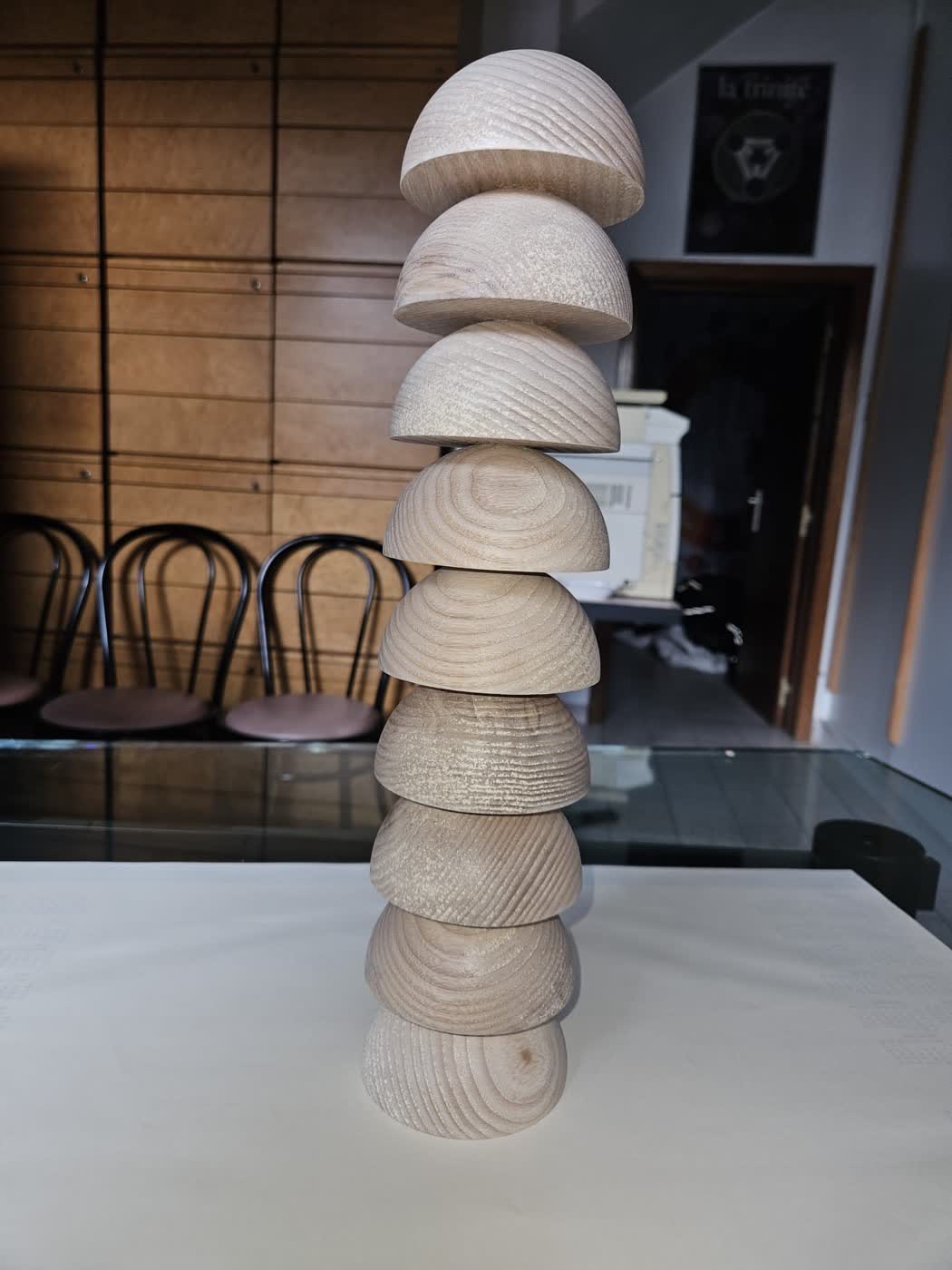
Some objects don't look like much. You walk past them without noticing. A small column on a shelf, made of half-spheres stacked one on top of the other, like a pile of upturned bowls or a tower of wooden mushrooms. Nothing shiny. Nothing blinking. No wire, no plug, no switch.
And yet.
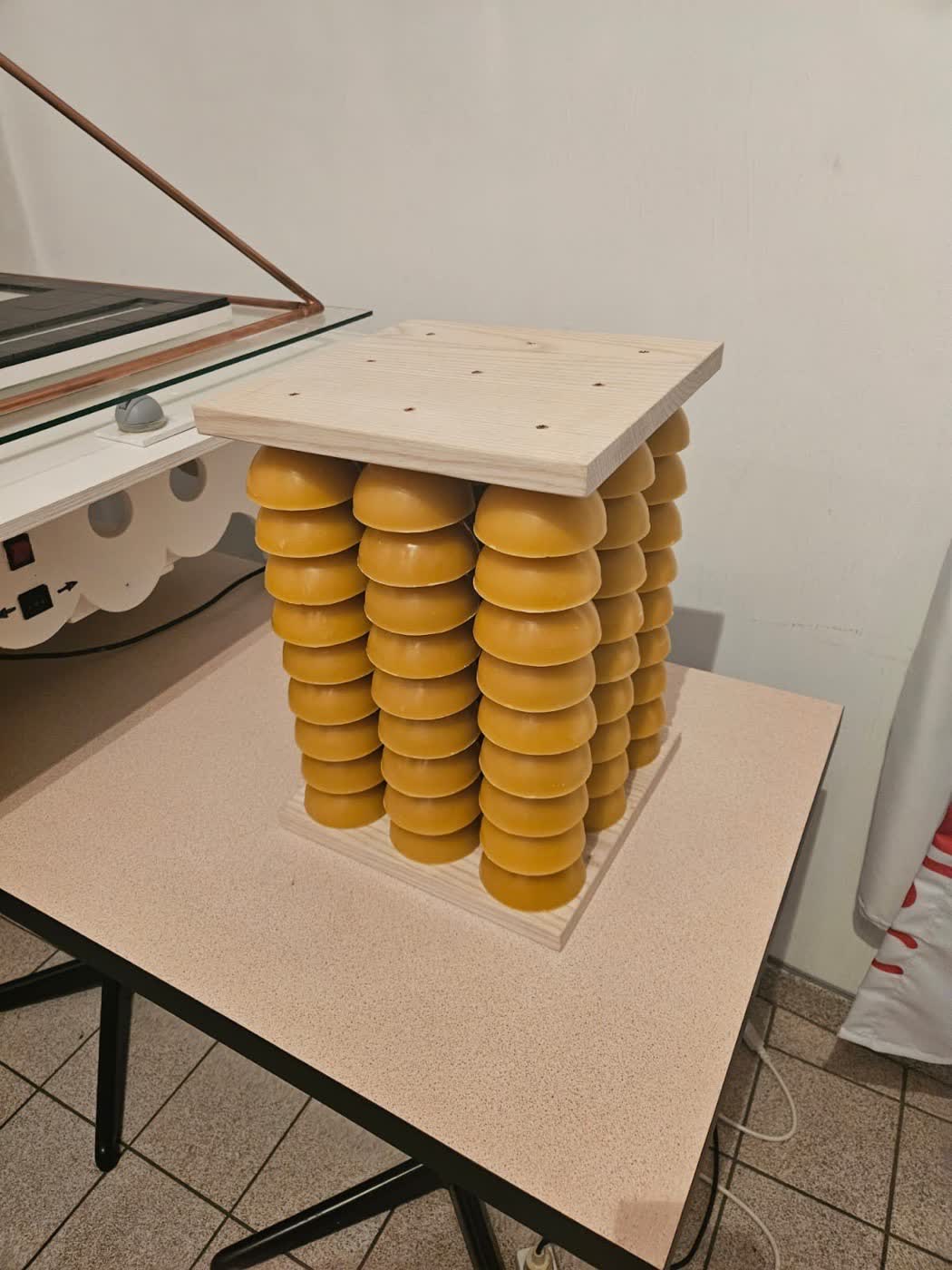
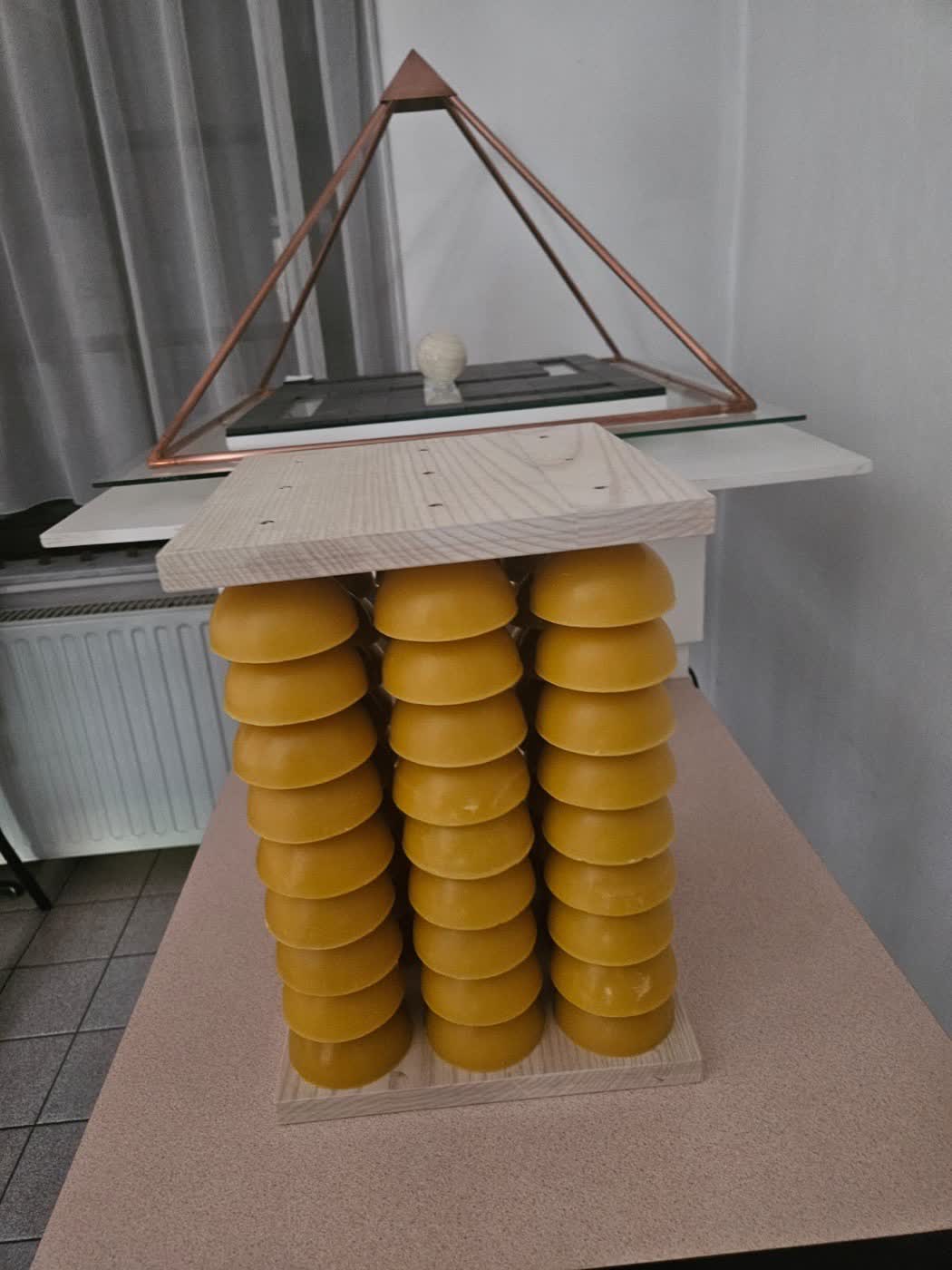
When you step into Antoine de Saint-Christophe's workshop in Herstal, they are the first thing to greet you. They are everywhere. In pale wood, on the workbench. In golden resin, packed tightly together under a copper pyramid. In clear acrylic, in a tall column that glows blue as night falls. Antoine simply calls them the piles. He has been building them for more than forty years.
Ask him why, and he smiles, sits you down, and starts by telling you about a château in Brittany.
The château of Carivan
We are in the 1930s, near Saint-Brieuc, in the Côtes-d'Armor. At the château of Carivan lives a strange and passionate man: Count André de Bélizal. A Breton gentleman and an engineer at heart, he has turned part of his home into a laboratory. Pendulums of every size, spheres of wood and metal, compasses, graduated dials, notebooks covered in measurements.
Bélizal is not alone. He works with another researcher, quieter but just as relentless: Léon Chaumery. Together they pursue an idea that seemed crazy at the time, and perhaps still does to many people today:
The shape of an object, on its own, produces an effect. Without electricity, without a motor, without any energy other than that of the Earth itself.
A sphere does not act like a cube. A cone does not act like a pyramid. A half-sphere resting on its flat side does not act like the same half-sphere turned upside down. And when you stack these shapes, their effects add up, exactly as the cells of an electric battery do.
They call this shape waves (in French, ondes de forme).
10 April 1936
On 10 April 1936, Léon Chaumery files a patent. It bears the number 816.132. It describes a small pile of four hemispheres, 12 millimetres in diameter, stacked one on top of the other. It is the very first dowsing pile ever officially registered.
Antoine knows this patent by heart. It holds pride of place in his archives, next to that of another pioneer, Dr Francis Frandeau de Marly, whom we will meet again. For Antoine, this date is a birth certificate: that of a line of researchers to which he belongs.
Three years later, in 1939, Chaumery and Bélizal publish their great work together, Essai de radiesthésie vibratoire ("An essay on vibratory dowsing"). The book would be reprinted for decades. In dowsing circles, it became a bible.
The price of discovery
What is less well known is that this research came at a price. A very heavy one.
On 27 February 1957, Léon Chaumery died. According to Bélizal himself, who tells the story in the foreword of a book published a few years later, his friend succumbed to the effects of one of the vibrations they were studying together: the dreaded negative green, a wave they did not yet know how to master. The pioneers of shape paid for their discoveries with their lives.
Bélizal carried on. With a new research partner, P. A. Morel, he went over everything again, checked everything, and in 1965 published a second book that became legendary: Physique micro-vibratoire et forces invisibles ("Micro-vibratory physics and invisible forces"). In it you find the antidote to negative green, dozens of devices, and an ethical rule the two men set themselves: their most powerful emitters would never be entrusted to just anyone.
Antoine has made this rule his own. It explains why some pieces in his workshop are not for sale: they are discovered, explained, and entrusted only after a conversation.
The hierarchy of shapes
In their work, Bélizal and Morel ranked shapes by their power. Here is the essence, as Antoine passes it on:
- The spiral stopped by a straight line, nicknamed the snail, is beneficial.
- The circle is the most balanced flat shape, more expressive than any other flat shape.
- The sphere is the most powerful solid shape of all. Its radiation goes from its centre outwards.
- The hemisphere, the half-sphere, has a unique property: you can stack it. And by stacking it, you build up its force.
That is the whole secret of the pile. A sphere is powerful, but it stands alone. Stacked hemispheres become a battery of shapes.
The four laws of the pile
Antoine sums up how a dowsing pile works in four very simple laws. He likes to compare them to those of an electric battery, because everyone understands them.
First law: the number makes the voltage. The more hemispheres you stack, the "stronger" the pile. The number of elements plays the same role as voltage.
Second law: the diameter makes the current. The wider each hemisphere, the more abundant the flow. Diameter plays the role of amperage.
Third law: regularity makes the progression. A pile whose hemispheres all have the same diameter, between 13 and 16 centimetres, gains power steadily, element after element.
Fourth law: growth makes the octave. A pile whose hemispheres get bigger from bottom to top no longer progresses in a straight line: it produces a series of octaves, like a rising scale.
And Antoine always concludes the same way: the more hemispheres, and the larger their diameter, the more powerful the pile. It is no more complicated than that.
The golden rule: flat sides up
There is one rule every pile owner must know, and Antoine repeats it to every visitor. A hemisphere has two faces: a dome and a flat side. And the way that flat side faces changes everything.
When the flat sides face upwards, the pile always emits what Bélizal called positive green: a beneficial effect. Piles oriented this way, Antoine writes, encourage mental order and increase the vibratory unity of a home when they are placed in each inside corner of the house.
When the flat sides face downwards, the pile emits the opposite. You never do this, unless you know exactly what you are doing and have the necessary harmonisers. In the workshop, the rule is simple: the flat sides look at the sky.
Antoine's advice for the home: four piles, one in each inside corner of the main room, flat sides up. It is the simplest way to bring shapes into your home.
Wood, crystal and light
A pile can be made of many materials, and each one has its own character.
Wood is the material of beginnings, warm and alive. But be careful, Antoine warns: if you make your hemispheres from a hard, even-grained wood, respect the polarity of the wood, vertical and horizontal. Wood turned against the grain does not give the same result.
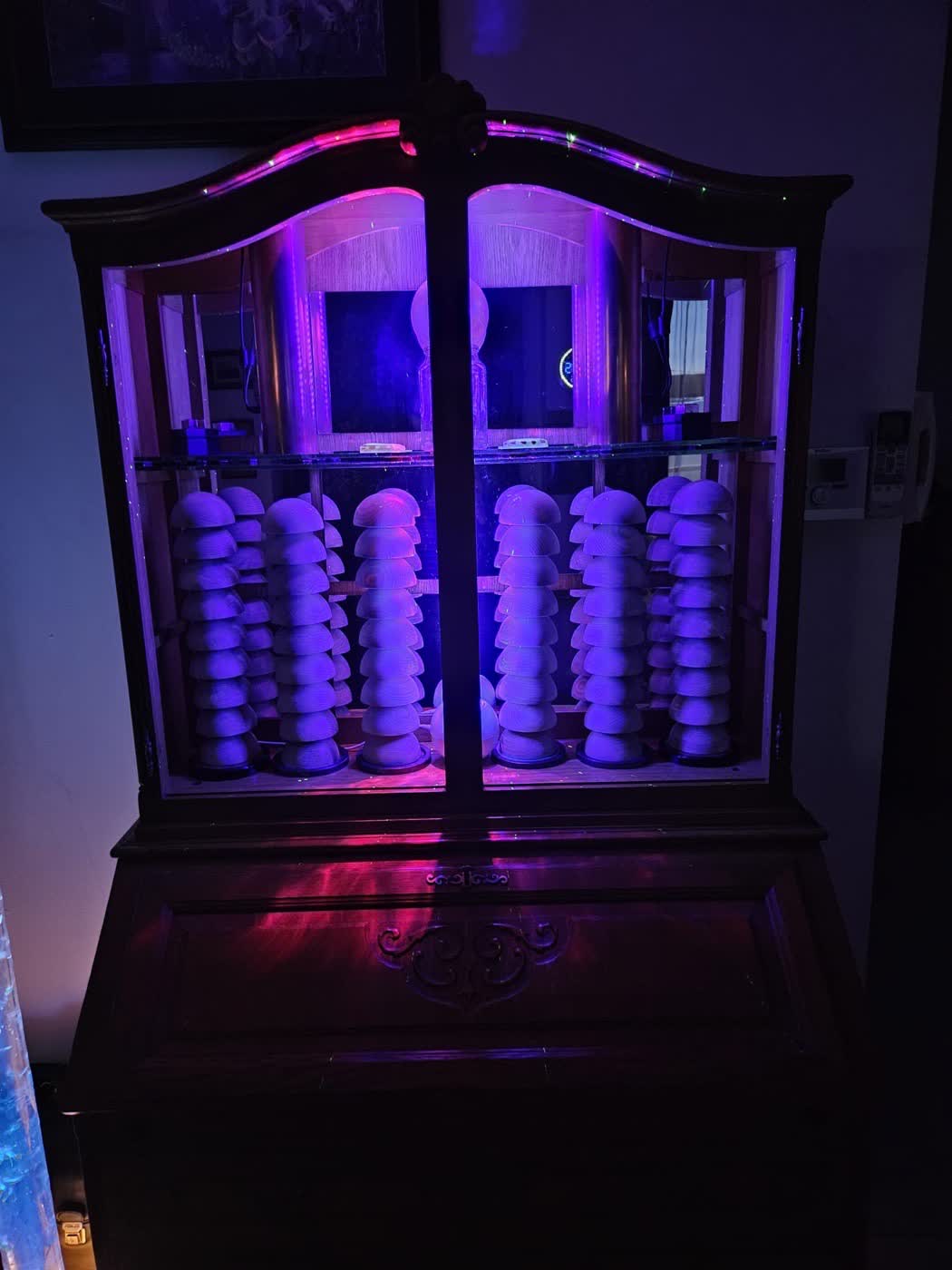
Crystal, and translucent materials in general, are for Antoine the ideal materials for experiments. Light passes through them. Some researchers even project coloured beams onto their piles, to study the combined effect of shape and light. It was along this path that Antoine built his great Kaprekar pile, a one-metre acrylic column with nine double resin hemispheres, nine litres of moving water and nine indigo lights (see also the Kaprekar pile in the workshop).
Finally, golden resin, which Antoine uses for his most recent piles, set in tight rows under a copper pyramid.
For his most personal work, Antoine uses a centrepiece: a pile of 32 rock crystal hemispheres. When he prepares an object for someone, he sometimes places a photograph of that person at the top of this pile for twenty-four hours: black and white, printed from a negative and handled as little as possible, oriented along the axis of its owner's birth sky.
The witness
Why a photo? Because in Bélizal's tradition, distance does not exist for form effects. What matters is the link. A black-and-white photograph printed from a negative, a fingernail, a lock of hair: these are witnesses. They connect the pile to the person, wherever they are.
Antoine likes to quote a line from his manual. Form effects do not travel at the speed of light. They act at zero speed: zero time, zero space, that is, wherever the operator wishes, immediately. Like the mind, which is everywhere at once.
In the infinitesimal intimacy of matter, there is spirit.
Albert Einstein, as quoted by Antoine
Otto Brock's three "cannons"
One man took the use of piles further than anyone else: Otto Brock, the German cosmobiologist whose work Antoine has taken up.
Brock never went out without his equipment. He always carried three small "cannons", as he called them: a Chaumery and Bélizal universal pendulum, model 5.4, fitted with four hemispherical piles, and an Egyptian-style emitting pendulum cut from rock crystal. With his pendulum, he "informed" his cannons with a colour, the one that dominated his own life line. Then he wore a pendant informed in the same way around his neck, flat sides up.
What came of it? Antoine tells it with a smile in his manual: Brock had to move from town to town very often, because wherever he went, luck seemed to follow him a little too closely.
The cosmo-magnetic pendant
A pile can also be worn. The finest example is the cosmo-magnetic pendant of Dr Francis Frandeau de Marly, patented in 1984 under number 84.03970. Antoine knows every one of its measurements:
- 39 millimetres high, 11 millimetres in diameter, 22 grams;
- brass plated with fine gold;
- three 12-millimetre elements, like a miniature Chaumery pile;
- a fourth element carrying a Fortuna Major selector, the figure of great luck.
Held vertically, its top emits positive green and its base negative green. It can be worn alone or combined with others, on yourself or on a witness. It can also be used as a pendulum, both detector and emitter. And Antoine adds a detail that delights him: it harmonises beautifully with all magic squares.
The ideal pile for the cell
One last name completes the line: Hans Heinrich Heckmann, cosmobiologist and friend of Otto Brock. Heckmann searched for what he considered the ideal tension for the living cell, the one that would keep each cell in perfect vibratory harmony: neither too fast nor too slow, neither too strong nor too weak. His answer became famous in dowsing circles: four 12-millimetre hemispheres.
Exactly Chaumery's pile, patented in 1936. Sixty years of research to land on the same little column of four elements. For Antoine, there is no better sign that this pile was the right one.
This is a dowsing tradition, not medicine: a pile diagnoses nothing and treats nothing. For any health question, see your doctor.
How long does a pile work?
It is the question everyone asks. In his Commodore manual, Antoine gives a precise table, measured on the Bovis scale, the dowsers' scale. After an activation, the intensity slowly decreases, in nine-day steps, over 108 days:
| Days | Intensity |
|---|---|
| 9 | from 100 to 92 |
| 18 | from 92 to 83 |
| 27 | from 83 to 75 |
| 36 | from 75 to 67 |
| 45 | from 67 to 59 |
| 54 | from 59 to 50 |
| 63 | from 50 to 42 |
| 72 | from 42 to 34 |
| 81 | from 34 to 25 |
| 90 | from 25 to 17 |
| 99 | from 17 to 9 |
| 108 | from 9 to almost 0 |
108, the sacred number of Eastern traditions: 108 names for each god in Hinduism, 108 beads on the rosary, 108 sun salutations for yogis. It is also, as you may have noticed, the number of days given by the Kaprekar constant for a deposit on Antoine's pile. With him, nothing is ever quite a coincidence.
From Carivan to Herstal
Today, the great names of this story are all gone. Chaumery in 1957. Bélizal a few years later. Otto Brock, Heckmann. Their books can still be found at second-hand booksellers; their patents sleep in the archives.
But in Herstal, in a workshop on the Place du 12ème de Ligne, someone is still turning hemispheres, stacking them, orienting them, measuring them. Someone who has read all those books, compared all those patents, and spent forty years checking for himself what they claimed.
Nothing is new except what has been forgotten.
Antoine de Saint-Christophe
And you?
You can start very simply: four small piles in the corners of your living room, flat sides up. You can wear a pile, in the form of a pendant. You can also entrust the workshop with a photo and a wish, to be placed at the top of one of Antoine's large piles.
Or you can simply come and see them. They are there, in Herstal, on the workshop shelves. They don't look like much. But now you know what they hide.
Write to the workshop: tell us what you would like to change at home, and we will tell you which pile would suit you and how to place it.
Frequently asked questions
What is a dowsing pile?
A column of stacked hemispheres. The first one, patented by Léon Chaumery on 10 April 1936, had four hemispheres 12 millimetres in diameter.
Which way should the hemispheres face?
Flat sides up: the pile then emits what Bélizal called positive green, a beneficial effect. It is the golden rule Antoine repeats to every visitor.
How long does a pile work?
In his manual, Antoine gives a table measured on the Bovis scale: after an activation, the intensity slowly decreases, over up to 108 days.
How do I start at home?
Four small piles in the corners of your living room, flat sides up. You can also wear a pile, in the form of a pendant.