Speak to the earth, and it shall teach thee.
Book of Job 12:8, at the top of entry 2-590004
Wéris, Oppagne and Morville. Three pretty little villages in the Ardennes, between Durbuy and Érezée, which share some of the most mysterious remains in the country. A land of legends, rich in vibrations, that archaeologists call the Wéris megalithic field, and that Antoine called more simply the land of lying and standing stones.
It is Belgium's capital of megaliths. And for Antoine, it was much more than that.
A cosmo-telluric whole
Antoine saw Wéris as one piece of a larger whole.
The megalithic site of Wéris and the Mont des Géants, in Vaux-sous-Chèvremont, were in his view part of a highly emissive cosmo-telluric whole (linking the forces of the sky and of the earth). And the rock of Roche-à-Frêne, in the Aisne valley, was nothing less than a gateway to the centre of the Earth, to the energies of the underworld, like Mount Bugarach in the south of France.
Three thousand years ago, people cut and raised the stones of Wéris. And these stones, Antoine noted, came from Roche-à-Frêne. The builders of that time, he wrote, had perfect mastery of the natural cosmo-telluric currents. Faced with these subtle and completely unknown energies, we will have to wait for science to progress before we understand the mystery of these old stones.
The roadside menhir
Your visit begins along the road from Barvaux to Érezée. A standing stone rises there: a menhir of local puddingstone, 3.60 metres (12 feet) tall, weighing nearly seven tonnes.
It is your first meeting with the stones of Wéris. Take the time to stand in front of it.
The dolmen
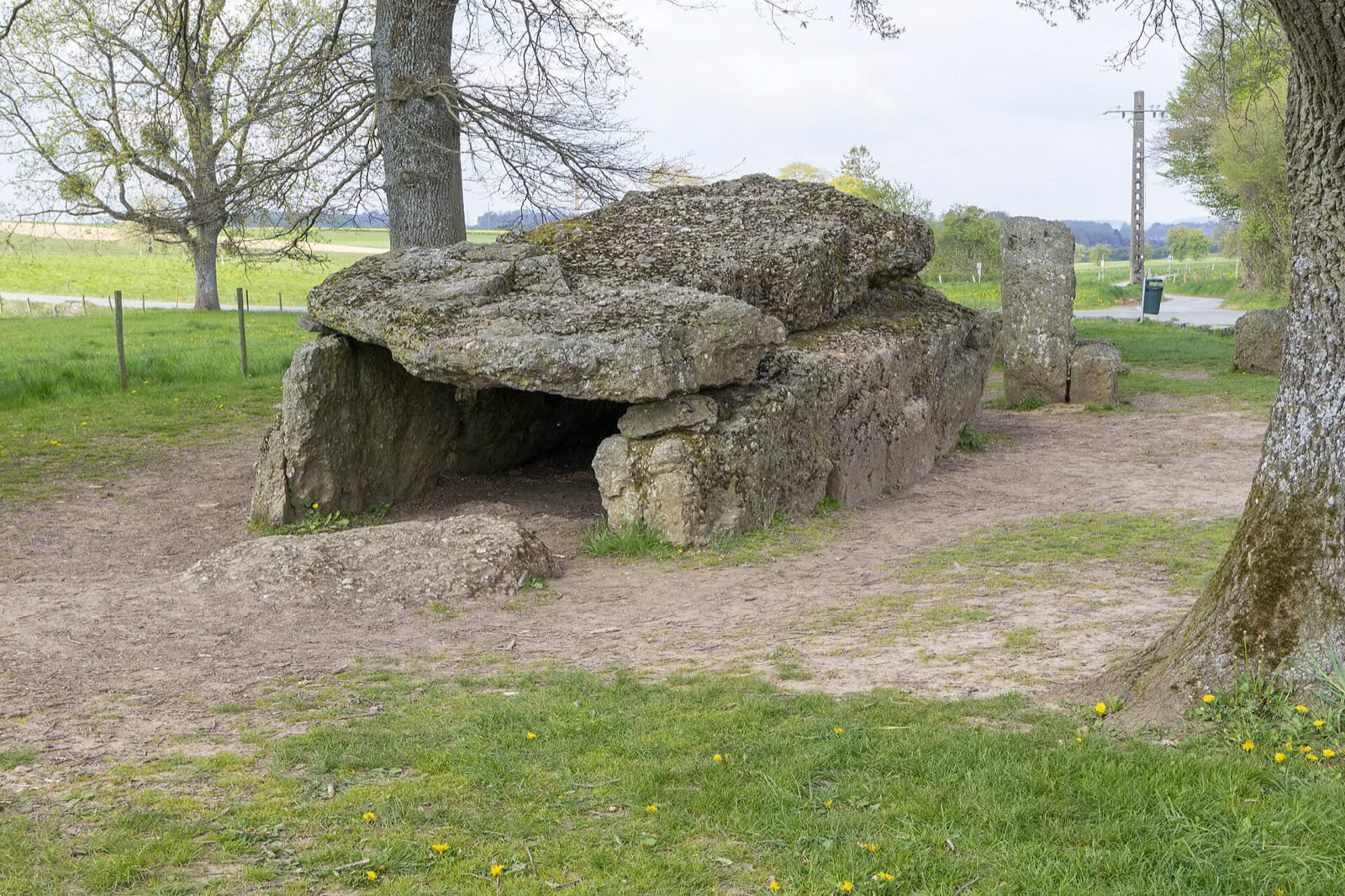
To the left of the same road stands the Wéris dolmen, a megalithic tomb of the covered passage type: over about ten metres, six upright blocks hold up two capstones eighty centimetres (over 2.5 feet) thick.
It is the monument you see at the top of this article.
The Haina stone and the cult of white stones
In Morville, at the place called Aux Écoulées, stands the Haina stone, a menhir more than three metres tall, partly cut and leaning towards the east, towards the rising sun.
Antoine reported a singular custom: until about 1900, the Haina stone was whitewashed with lime at every spring equinox. For a very particular reason, he said: the cult of white stones.
The Devil's Bed
Not far away lies a curious polished stone 2.40 metres (8 feet) long: the Lit du Diable, the Devil's Bed.
Antoine spoke of it with a caution rarely seen in him. It is, he wrote, a real challenge, just like crossing the "Pasé del Neûr Poye" (a path in Haccourt, near Liège) on the night before All Saints' Day.
His rule was absolute: never lie down on the Devil's Bed.
Roche-à-Frêne and the infernal dyke
Antoine recommended carrying on to Roche-à-Frêne, where the stones of Wéris come from, and to the remains of the "digue infernale" (the infernal dyke), where an object is said to have been buried underground since prehistoric times.
The white pebbles of the Mousny
And to finish, he advised going up to the high plateau of Hives and Ortho, near La Roche-en-Ardenne, to see the white pebbles of the Mousny. Their dazzling, almost glowing whiteness is explained by a local legend. Antoine recommended bringing a Lecher antenna, a dowsing instrument, and holding it firmly: on this site, he said, and for good reason…
The brigands and the lost gold
The Ardennes around Wéris also have their treasure stories.
Legend has it that two famous Ardennes brigands, Gena and Magonet, still haunt the area, especially around Bel-Air and Bel-Hé, where they are said to have left so much behind. If you lose a gold jewel nearby, go to Saint-Antoine, the main pilgrimage site close by, and ask the saint to help you find what you no longer have.
Antoine also reported that a famous dowser, Monsieur Decalut, had predicted that a Frenchman, with a small group, would discover the bulk of a hoard buried in the rocks of Ozo. "To be continued," Antoine wrote. "Good old Monsieur Decalut, still very present despite his absence."
Visiting Wéris
The Musée de la Pierre (Stone Museum) in Wéris presents the whole site and its legends. To get around the megaliths, Antoine noted that a vehicle and excellent walking shoes are essential.
In the past, he even ran introductory weekends with a geobiologist in the land of lying and standing stones, to learn how to measure the vibration level of the menhirs, the dolmen and the Devil's Bed.
Antoine's advice
If you can, always take a miniature bottle of verbena with you when you go to a megalithic site.
Antoine de Saint-Christophe
Back to the map of places of luck
Would you like to discover Wéris with Antoine's keys, or know which stone matches your request? Write to the workshop.
Photos: JackyM59 (CC BY-SA 4.0) and Romaine (CC0), via Wikimedia Commons.
Frequently asked questions
What is there to see in Wéris?
The 3.60-metre menhir along the road from Barvaux to Érezée, the covered passage dolmen, the Haina stone in Morville and the Devil's Bed. The Musée de la Pierre presents the whole site.
What is the cult of white stones?
A custom reported by Antoine: until about 1900, the Haina stone was whitewashed with lime at every spring equinox.
How do you visit the megaliths?
Antoine noted that a vehicle and excellent walking shoes are essential. He advised going on to Roche-à-Frêne and the white pebbles of the Mousny.