How to raise the vibrational level of the place where you live, and welcome your wishes there.
Card 2-431000, Antoine de Saint-Christophe
Of the dozens of rituals Antoine practised and passed on, there is one he placed above all the others. The most complete. The most demanding. And, in his view, the most powerful: the full Saint Ambrose ritual.
It is a ritual of light. It rests on an exceptional material, a precise geometry and a celestial calendar. It takes place at four moments in the year, at the two equinoxes and the two solstices, and each time in seven burnings. It cannot be improvised. But for those who see it through, Antoine wrote, it transforms the atmosphere of a home and speeds up the fulfilment of wishes like few other practices.
Here is the ritual as he described it, step by step.
Saint Ambrose, the child of the bees
Ambrose was born in Trier around 337. He was the son of Ambrosius, praetorian prefect of the Gauls, one of the highest-ranking men in the Roman Empire.
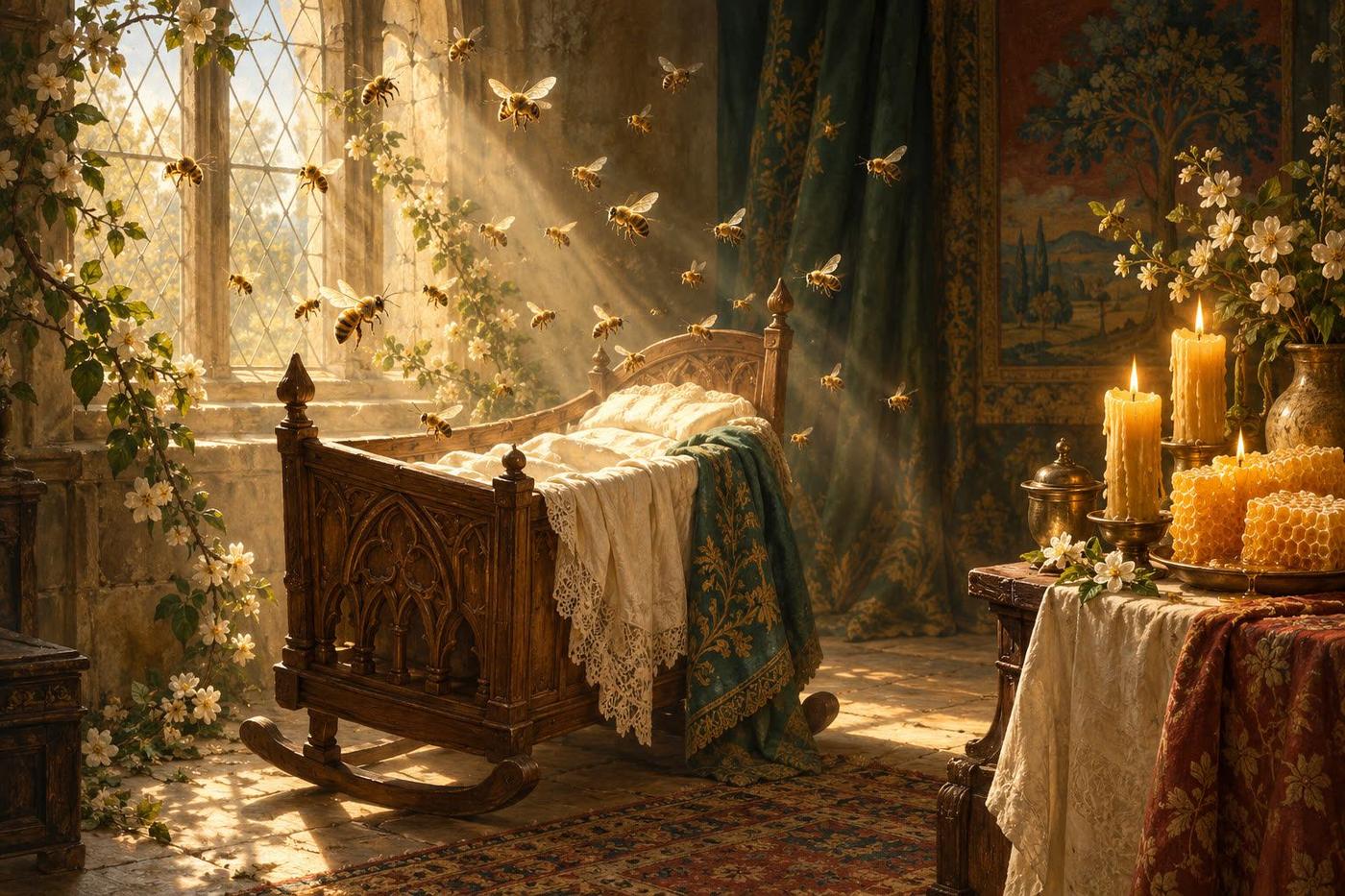
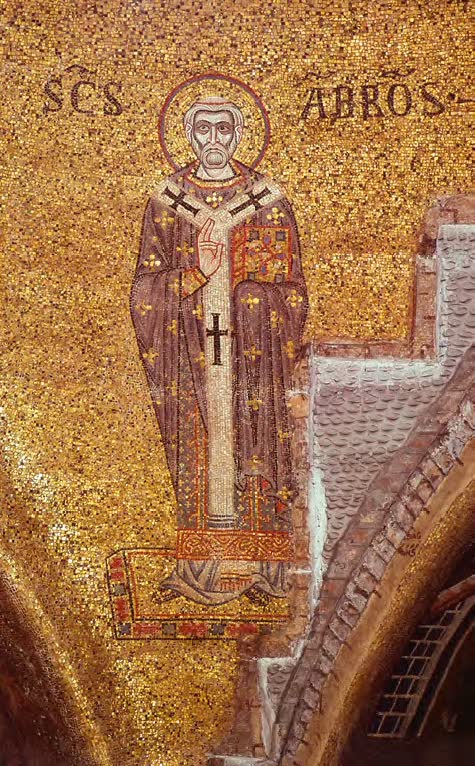
Legend says that one day, as he slept in his cradle in the hall of the praetorium, a swarm of bees came down on him. The bees covered his face, so thickly that people thought they saw them going in and out of his mouth. And not a single one stung him. His father, deeply moved, is said to have cried out: “If this child lives, what a destiny he will have!”
Ambrose became a lawyer, then a senior official, then governor of the province whose capital was Milan. And one day in 374, as he passed through the city, the people of Milan elected him bishop by acclamation. He was consecrated on 7 December, which is why beekeepers celebrate him on that day. He died in Milan on 4 April 397.
Today he is the patron saint of beekeepers, candle makers and gingerbread bakers, and the protector of bees. A French country saying goes: À la Saint-Ambroise, huit jours de froid (“on Saint Ambrose's day, eight days of cold”).
A saint born under the sign of the bees. It was only natural that the greatest wax ritual should bear his name.
The material: pure capping beeswax
The whole ritual rests on a single material, and Antoine accepted no compromise: pure capping beeswax, which he abbreviated to PCAO (its French initials).
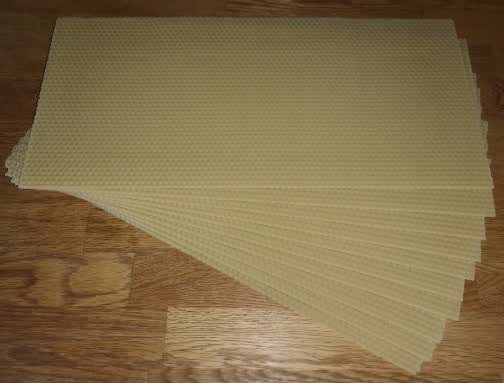
The cappings are the thin layers of wax that bees use to seal the cells full of honey. It is the purest wax in the hive: the wax that seals the treasure.
This wax, free of any trace of paraffin or stearin, has qualities that Antoine described with admiration:
- it gives off a very large quantity of negative ions, which, he said, soothe and energise us at the same time;
- it gives a deep, calming yellow glow, which creates a soft, warm atmosphere;
- it freshens the air in the room;
- its very subtle scent is welcoming, heady, gentle and soothing.
Why an exceptional wax
Antoine recommended ordering this wax from Italy, at a much higher price than a local beekeeper's. He explained why with a comparison everyone understands: the higher the octane rating of a fuel, the more controlled the combustion and the better the engine is protected. Premium 98 is better than 95. The same goes for wax.
A wax containing paraffin and stearin is useless for this kind of work. Better to turn to a completely different ritual, because nothing will come of it. It is simply like putting water in your wine!
Antoine de Saint-Christophe
Never remelt
Another rule: there is no point in remelting the drips of your burnt candles to make new ones. The vibrational level of these “rebuilt” candles would be greatly reduced. They are good only for lighting a room.
And Antoine noted a curious observation: the burning time varies with the humidity of the air and with the vibrational level of the place. The better these values, the longer the candle lasts. On average, a twisted PCAO candle burns for 180 minutes.
The twisted candle and its vortex
Antoine made his candles himself, and he explained how.
First you need a stainless-steel double boiler, to melt the wax over a low heat. Then a silicone mould for twisted candles.
The shape of this mould is not decorative. Its four spiralling lines help the drips run off and create a form effect of nine twists. And these nine twists, Antoine wrote, give birth to a vortex that perfectly regulates the emission of negative ions. It is the lesson of form effects applied to the flame.
The model he used measured 18 millimetres in diameter and 200 millimetres high, for 35 grams of melted wax, with a flat wick of 3 by 10 millimetres.
One wick, always. Never use two wicks side by side: the flame would be much higher, and the candle would burn far too fast.
The language of the flame
While the candle burns, the colour of the flame speaks. Antoine referred to the treatise of the flame from the Yggdrasill tradition:
| Flame colour | Plane | What it announces |
|---|---|---|
| Yellow | Material | The holes in your aura are slowly closing |
| White | Mental | Serenity is wrapping around you |
| Blue | Spiritual | Your thoughts are on their way to coming true |
The statuette of Saint Ambrose
The ritual also calls for a statuette of Saint Ambrose, cast in exactly the same wax as the candles. Antoine's statuette was 21 centimetres tall, for 255 grams of wax.
One absolute rule: the statuette is never burnt. Burning it would wipe out its protective form effect, then weaken its egregore of kindness. It keeps watch; it does not burn away.
The seven-branched candelabrum
The heart of the ritual is a seven-branched candelabrum, a menorah, in gilded brass. Each branch is devoted to one of the seven classical planets, with its number, its day, its metal and its frequency.
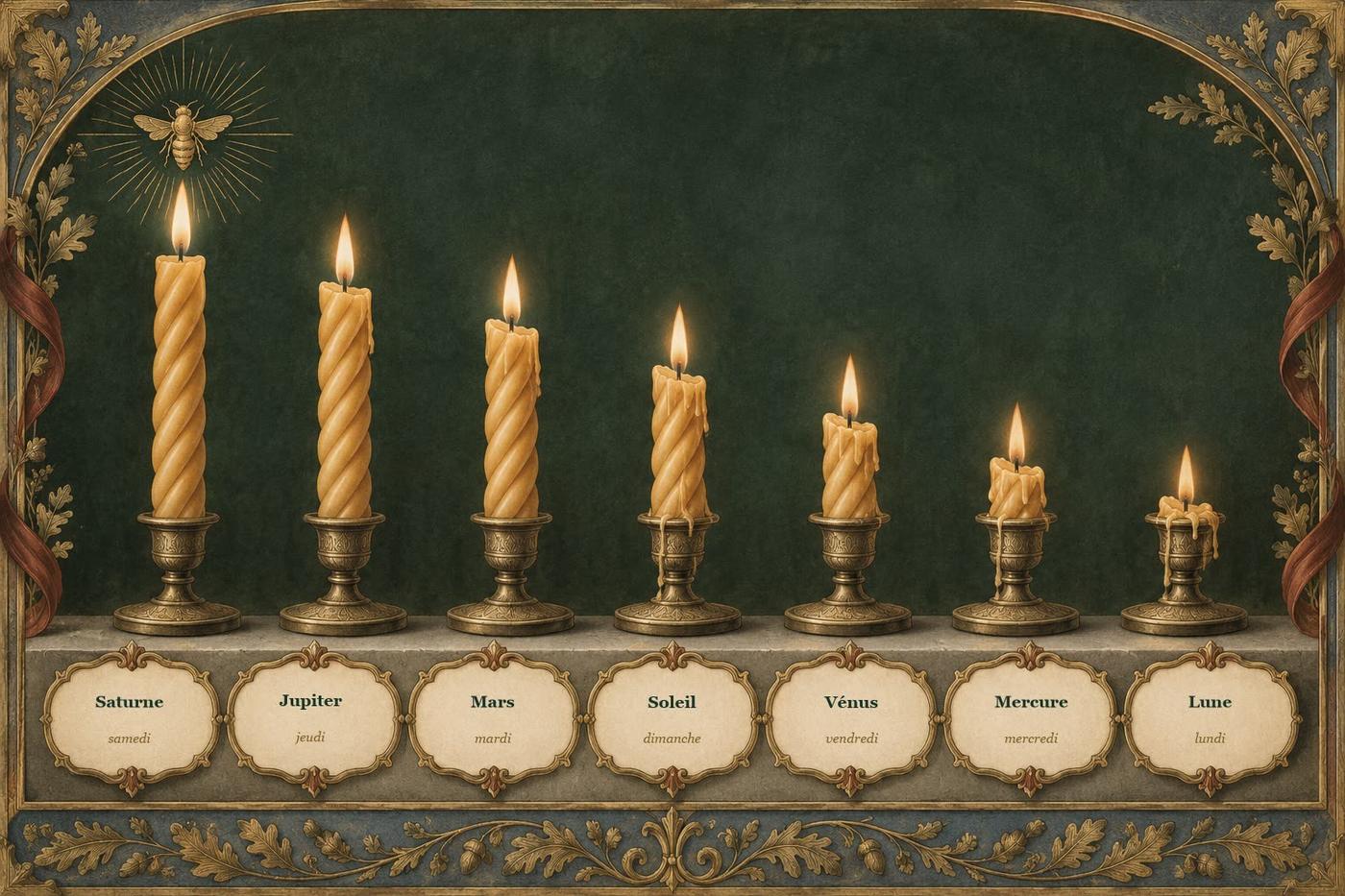
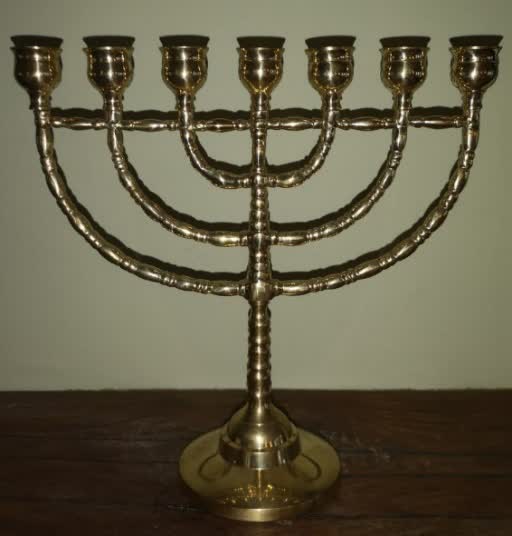
| Branch | Planet | Day | Metal | Tuning fork |
|---|---|---|---|---|
| 6 | Saturn | Saturday | Lead | 147.85 Hz |
| 7 | Jupiter | Thursday | Tin | 183.58 Hz |
| 2 | Mars | Tuesday | Iron | 144.72 Hz |
| 3 | Sun | Sunday | Gold | 126.22 Hz |
| 4 | Venus | Friday | Copper | 221.23 Hz |
| 8 | Mercury | Wednesday | Mercury | 141.27 Hz |
| 9 | Moon | Monday | Silver | 227.43 Hz |
You need twenty-eight twisted candles for the year: seven burnings, four times.
The rules of fire
Antoine was uncompromising about the gestures.
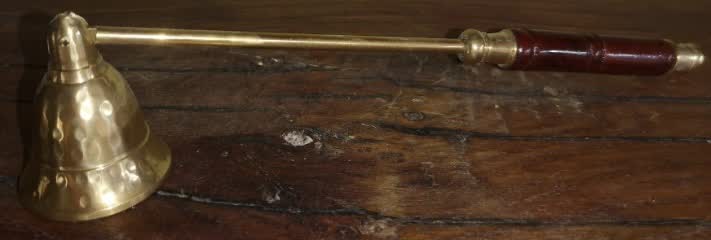
To light: an ordinary match. Never a flame that is already burning, such as another candle or a lighter left on.
To put out: a candle snuffer. Never your breath. Blowing on a candle, he said, sets the element of air against the element of fire, and that greatly disturbs the energies released.
The place: once set down, the candelabrum does not move until the seventh burning of each ritual.
Fire safety. A candle burning for three hours is a real flame. Never leave it unattended, keep it away from curtains, paper and anything that can catch fire, out of reach of children and pets, on a stable, heat-proof surface.
The four rituals of the year
The Saint Ambrose ritual is performed four times a year, following the rhythm of the Sun:
- the March equinox ritual;
- the June solstice ritual;
- the September equinox ritual;
- the December solstice ritual.
Each ritual has seven burnings. They don't have to follow one another day after day, but they must belong to the same season, between the same equinox and solstice. You can start on any day of the week.
The exact moment: when the day and the hour agree
This is where the ritual becomes a matter of astronomy.
Each day of the week is ruled by a planet. And so is each hour of the day, in turn: these are the planetary hours, which are easy to work out today with a small program or an app. The Saint Ambrose rule is simple: you only light the candle when the ruler of the hour is the same as the ruler of the day.
Antoine gave a real example, calculated for Herstal.
Example. It is a Saturday, at 5:30 pm. Saturday is ruled by Saturn, but the hour of 5:30 pm is ruled by Mercury. So you wait until 7:32 pm, when Saturn rules the hour again.
At that moment:
- Place a twisted candle in branch no. 6, the branch of Saturn.
- Rub your hands with bee venom, as Antoine prescribed. If you are allergic to bee stings, leave out this step.
- Light the candle with a match, and let it burn until it goes out by itself, after about 180 minutes.
- Throughout the burning, wear the pentacle of Saturn around your neck, and sound the Saturn tuning fork for six minutes, as many as the number of its branch.
- Do not remove the wax that has dripped onto the branch.
The next day, Sunday, it will be branch no. 3, the Sun's, at the hour of the Sun, with its pentacle and three minutes of tuning fork. And so on, until all seven branches have burnt.
After the seven burnings
When the seven candles of a ritual have burnt, scrape the drips off the candelabrum with a wooden spatula.
Careful. Never throw this leftover wax in the bin, down a rubbish chute or in the toilet.
Place it in a large clear glass bowl on a stem, and set the statuette of Saint Ambrose in the centre. It will stay there for twelve months after the fourth ritual.
Then bury this leftover wax in the earth, choosing the place carefully:
- preferably near a dovecote or a former pigeon-racing club, or near an equestrian centre: racecourse, riding school, stables;
- otherwise, somewhere life feels good: near a charming hotel, a fine restaurant, or a busy tea room.
And always avoid places of suffering and sorrow: cemeteries, crematoriums, hospitals, care homes, prisons, courthouses, zoos, rubbish tips.
The emitter blocks: your wishes in wax
The Saint Ambrose ritual does not stop at lifting the atmosphere. It carries wishes. For that, Antoine made emitter blocks.
- Take a small clear glass jar with four flat vertical sides, holding 212 millilitres.
- Fill it with 212 millilitres of pure capping wax.
- On the first side, stick your personal magic square, printed on a translucent laminated sheet.
- On the side to its right, the wish square of your choice, from the 72 angelic squares. For ultimate protection, Antoine chose square no. 24.
- On the next side, your personal activator.
- And on the last, the activator of the wish square.
One jar per wish. You can stack several.
As an option, Antoine added a second jar filled with pure black seed (nigella) oil, bearing on two opposite sides the runic code of your choice.
The square of the Earth and its four cells
The whole set-up stands on the square of the Earth, the “mother card”, ideally printed large, in A3 format.
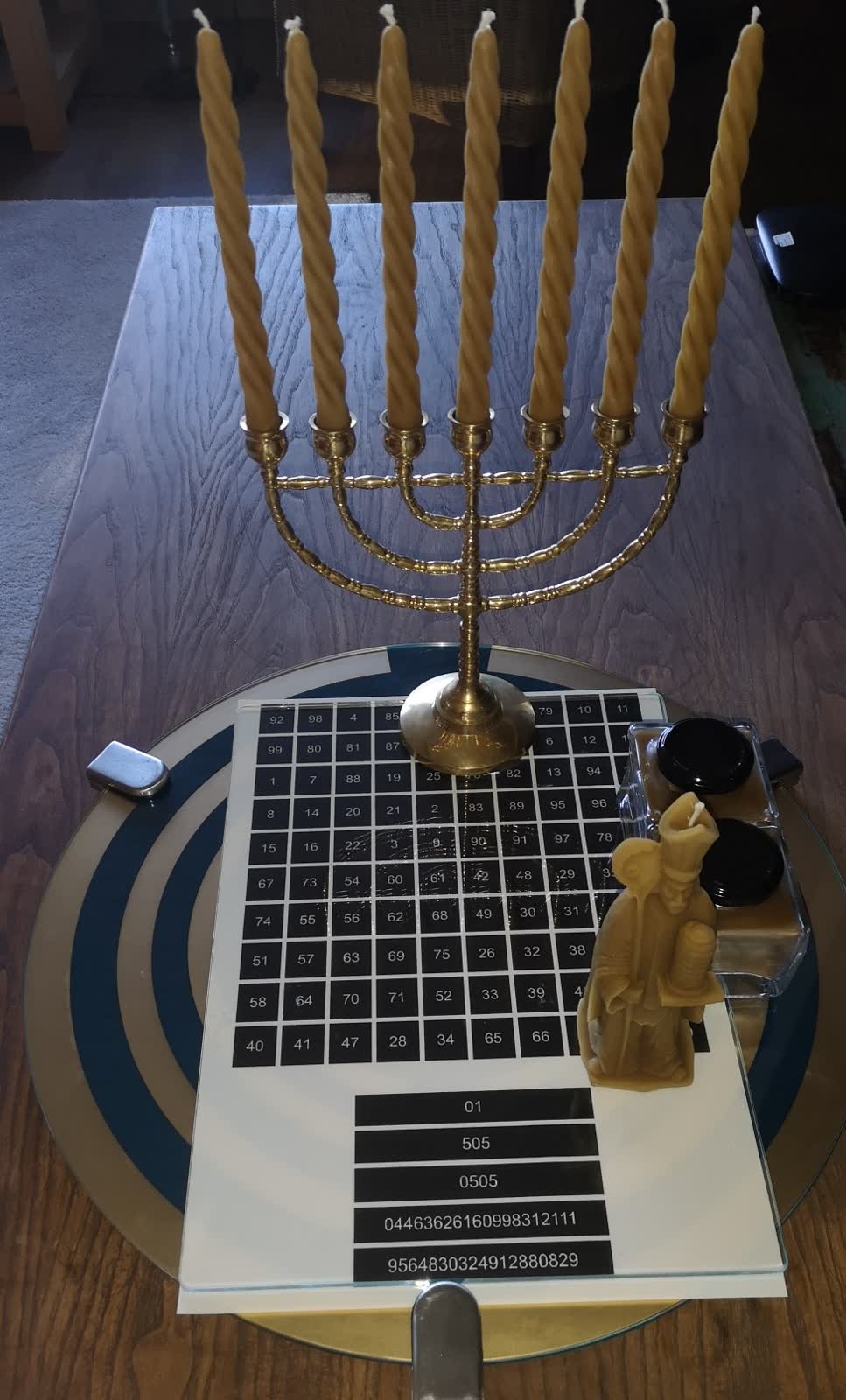
But not just anywhere. Only four cells of the square of the Earth are activated. Antoine worked them out from the first row of the square, 2409, 67, 2407, 57, by four theosophical reductions. It is a fine demonstration of his method.
| Method | Calculation | Cell |
|---|---|---|
| Sum of the numbers | 2409 + 67 + 2407 + 57 = 4940 → 4 + 9 + 4 | 17 |
| Sum of the digits | 2 + 4 + 9 + 6 + 7 + 2 + 4 + 7 + 5 + 7 | 53 |
| Product of the numbers | 2409 × 67 × 2407 × 57 = 22,144,330,197 → sum of the digits | 36 |
| Product of the digits | 2 × 4 × 9 × 6 × 7 × 2 × 4 × 7 × 5 × 7 = 5,927,040 → 5 + 9 + 2 + 7 + 4 | 27 |
Zero, Antoine reminded us, never counts in a theosophical reduction. Cell 17 is the one used most often.
On each of these four cells you can place the statuette of Saint Ambrose, the foot of the candelabrum, an emitter block or a stack of blocks. The other numbers of the square, even if covered, play no part: only cells 17, 27, 36 and 53 are activated by what stands on them.
Going further
Antoine suggested several more reinforcements, all optional.
Measuring the place. With a Bovis scale and a universal pendulum, you measure the vibrational level of the room before and after the ritual.
Orgone. An outdoor orgone antenna, or an indoor orgone diffuser, near the place of the ritual. Read: the benefits of orgone.
The resonance table. The square of the Earth and its components can be placed on a Lakhovsky disc, with its oscillator turned 22° 50' to the right of true north.
Music. Relaxing music in which the sound of a rain stick comes back regularly strengthens the evenness of the vibrational level and the spread of the harmonics.
Ambrosius. For those who drink alcohol, a bottle of Ambrosius placed on one of the four cells during the burnings intensifies and speeds up, he said, the fulfilment of wishes. And you can sip it in the glow of the flame and the music. Alcohol is always enjoyed in moderation.
At home or at a distance
The four Saint Ambrose rituals can activate one or more wishes for the same person, at home, but also at a distance. Antoine used to guide each person by phone, for the planetary hours and for the choice of emitter blocks: squares, runic codes and other sigils.
For those looking for a more direct effect, he also developed pictographic resonance, which he said produced the same effect as the full Saint Ambrose ritual. And there is a variant devoted to love: the chessboard ritual, with the berry of the tree of luck.
Would you like to entrust one or more wishes to the Saint Ambrose ritual? Write to the workshop: we will tell you how to prepare it, or perform it for you.
Frequently asked questions
Why Saint Ambrose?
Legend says that when he was a baby, a swarm of bees settled on his face without stinging him. The saint of bees is the natural patron of a ritual made entirely of pure wax.
Which wax should I use?
Only pure capping beeswax (PCAO): the wax that seals the cells full of honey, the purest in the hive.
When is the ritual performed?
Four times a year, following the Sun: at the March equinox, the June solstice, the September equinox and the December solstice, at the hour when the day and the planetary hour agree.
Can the statuette be burnt?
Never. The statuette of Saint Ambrose keeps watch; it does not burn away. Burning it would wipe out its protective effect.
Free guide · Alchimixe GPS
Stack the Odds in Your Favor
Feel like it always lands on you? A bad patch has a shape, and a calendar to get out of it.
Get the free guide