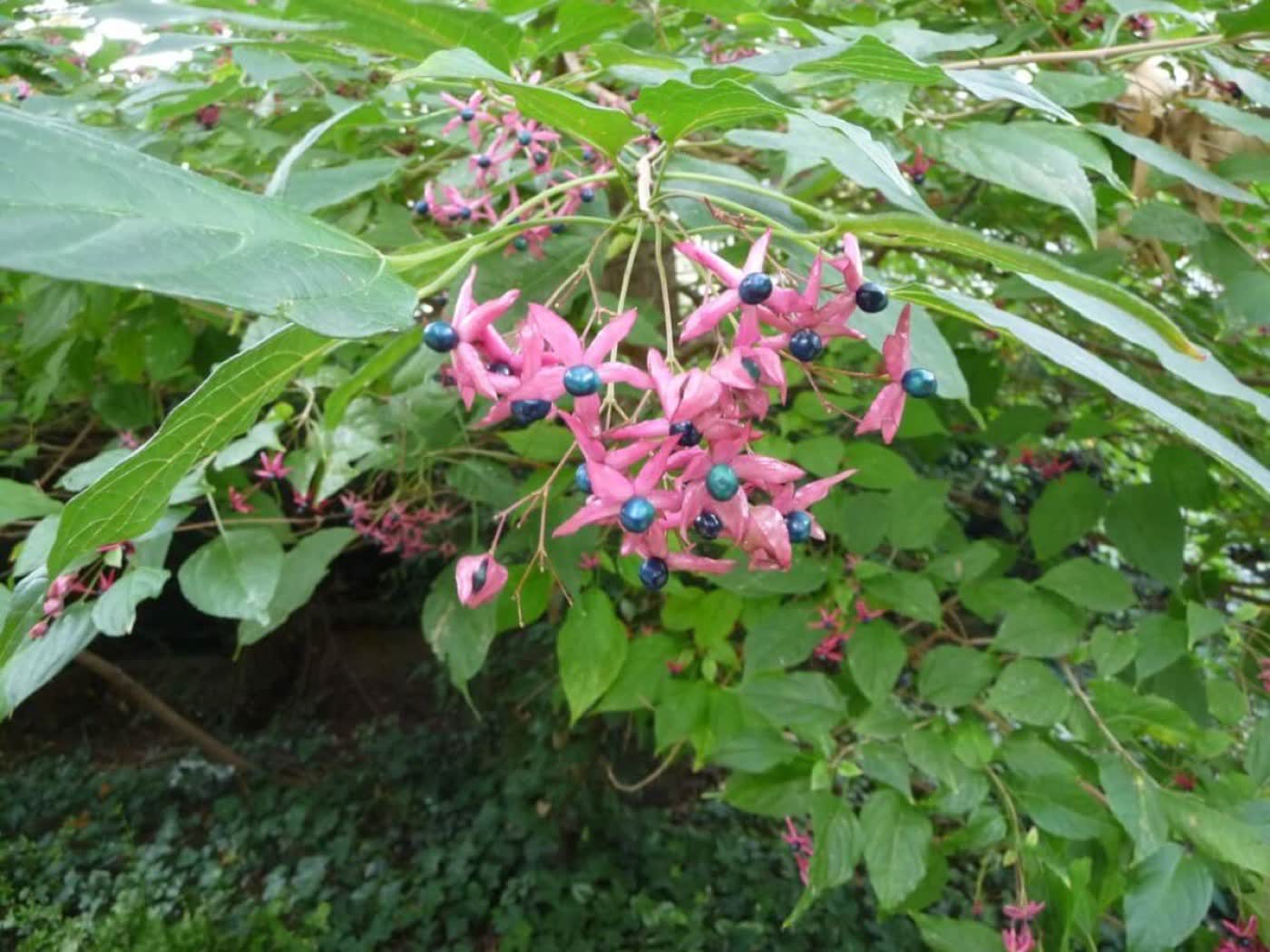
It grows in some gardens as a simple ornamental plant, and most people who walk past know nothing about it. Antoine knew it well. He made it the heart of one of his best-known rituals.
Its scientific name: Clerodendrum trichotomum. Its common names: the tree of luck, or the clergy tree (in English gardens it is also called the harlequin glorybower).
A name that says it all
Antoine liked to start with the name, because for him a name is an omen.
Clerodendrum comes from the Greek klêros, which means at once drawing lots, luck and the clergy, and from dendron, tree. The tree of drawing lots.
Trichotomum comes from treis, three, after the three branchings of its flower clusters. A tree built on the principle of three.
The tree of luck, built on the number three: no wonder it caught the attention of a man who spent his life looking for the hidden numbers of things.
A tree for every season
The tree of luck comes from Asia. It is grown for the beauty and the scent of its flowers.
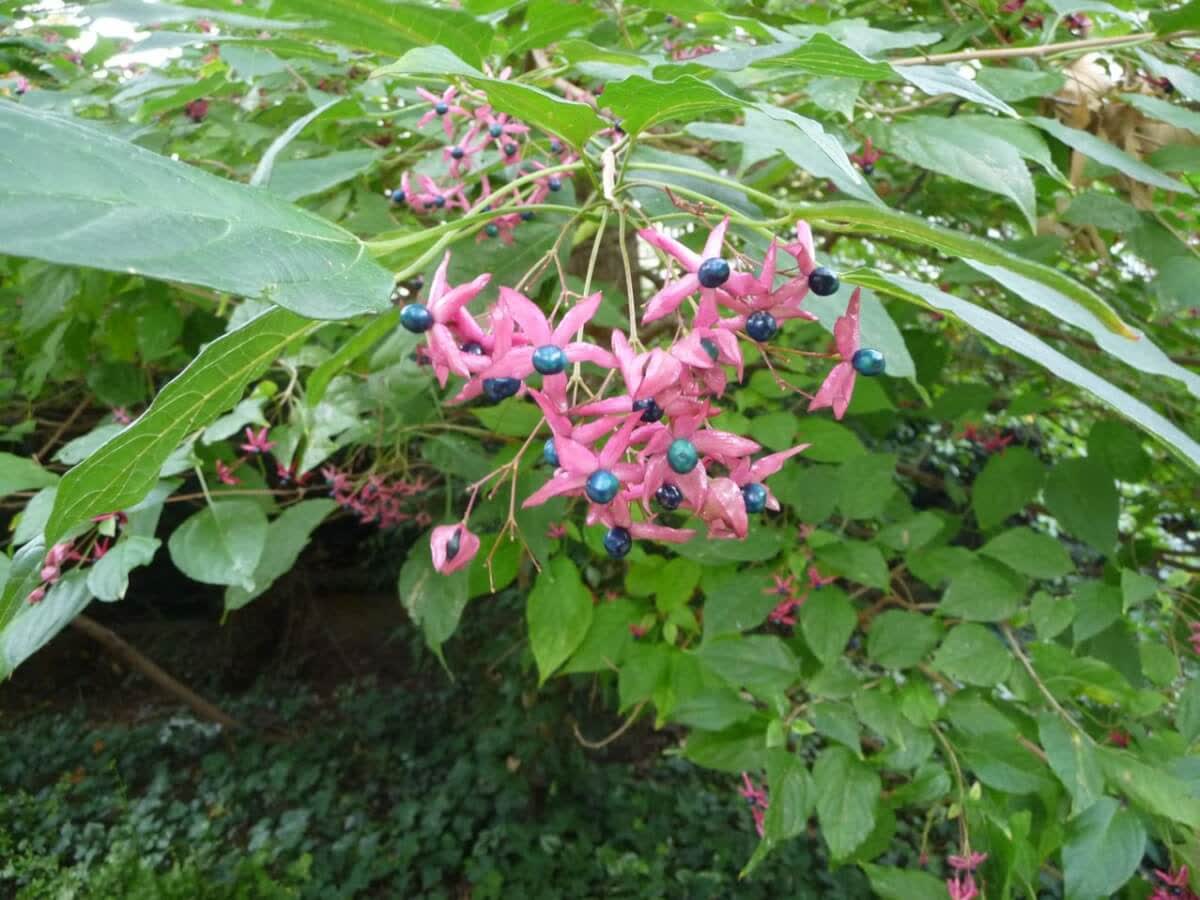
In summer, it covers itself in clusters of flowers in rare, exotic colours. Their sweet jasmine scent carries several metres around. Its nectar-rich flowers are constantly visited by bees and butterflies: it is one of the bees' favourite refuges. A detail that mattered a great deal to Antoine, the man of the Saint Ambrose ritual.
In autumn comes the show. The tree bears its fruit and its colours at the same time. Each fruit is a small drupe six to seven millimetres across, turquoise blue, turning midnight blue as it ripens. It sits at the centre of a carmine-red calyx whose five lobes open like a star. Porcelain-blue pearls on red stars, sparkling in the light. Each berry holds four seeds.
These berries are not to be eaten. But they have other powers.
Wax figurines: a magic two thousand years old
To understand the ritual, we first need to talk about dagydes.
The word comes from the Greek dagos, doll. A dagyde is a wax figurine that represents a person, a couple, sometimes an animal or a house. For Antoine, it is neither a toy nor a fetish: it is a condenser, which resonates with the energies and the intention of the person using it.
The practice is very old. Magic dolls have been found in the sanctuary of Isis and Mater Magna in Mainz, dating from the 1st to the 3rd centuries. Apuleius mentions them in his Metamorphoses, in the 2nd century. And wax figurines were widely used throughout Europe in the Middle Ages.
Antoine distinguished three materials, from weakest to strongest:
- paraffin, a recent material made from petroleum, with no egregore at all;
- tallow, animal fat, the candle of the poor in times past;
- pure capping beeswax, the candle of the rich, the noblest of all.
The berry in the wax
Here is the secret of the ritual. The first and main use of the tree of luck, Antoine wrote, is to place a berry in pure capping beeswax while it is still liquid.
The result is an androgynous figurine of pure capping wax with clerodendrum: a figurine that unites the masculine and the feminine, with a blue pearl from the tree of luck at its heart. It is the essential ingredient of the “masterly” success of the rite that follows.
The chessboard ritual
The chessboard ritual is, Antoine said, a variant of the great Saint Ambrose ritual. But it is entirely devoted to love.
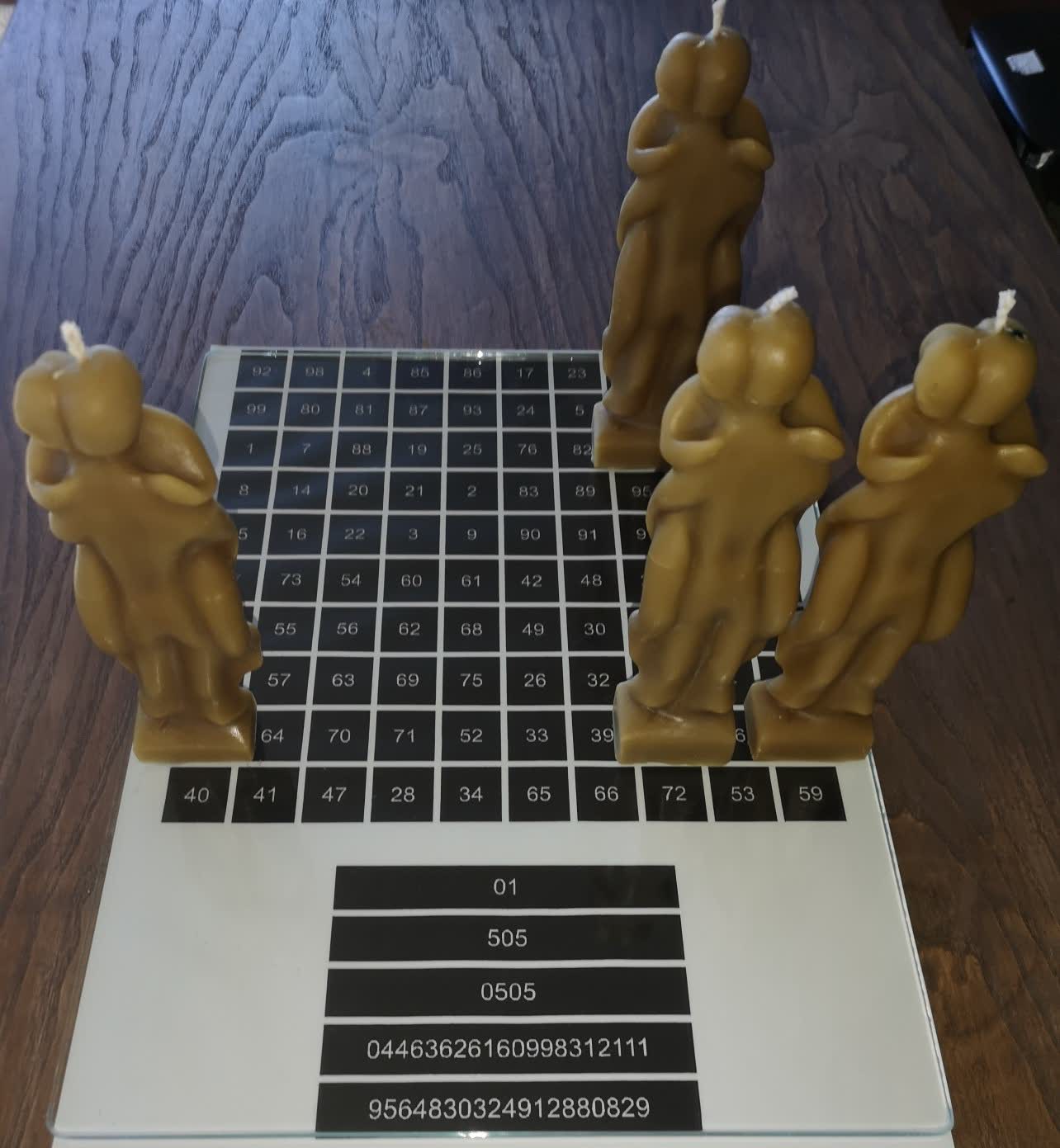
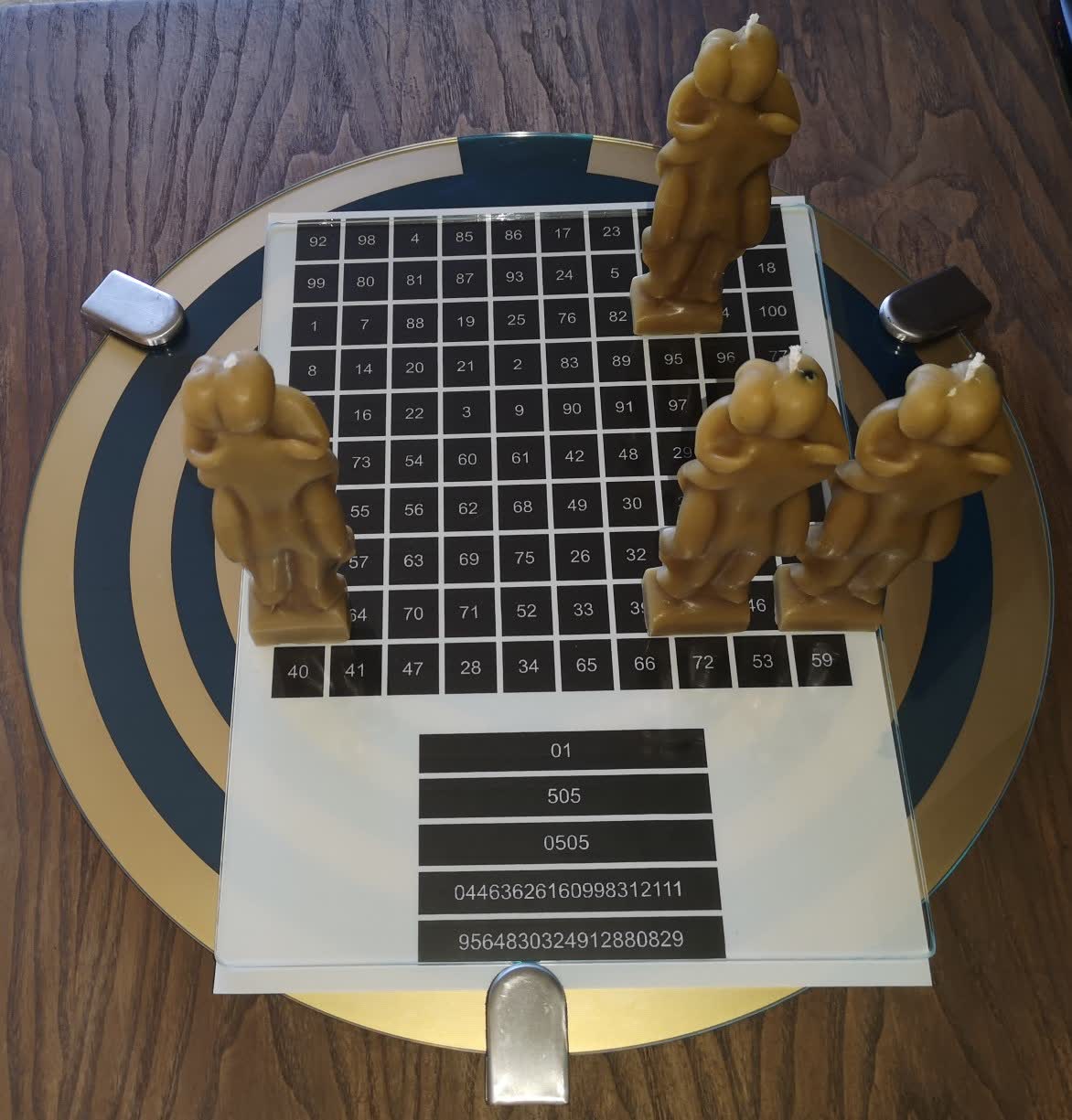
What you need: a square of the Earth with its activation codes, ideally in A3 format, and four androgynous figurines of pure capping wax with clerodendrum.
The four cells
As with Saint Ambrose, only four cells of the square of the Earth are activated. But for the chessboard, Antoine worked them out from another row of the square: 1362, 99, 1359, 91.
| Method | Calculation | Cell |
|---|---|---|
| Sum of the numbers | 1362 + 99 + 1359 + 91 = 2911 → 2 + 9 + 1 + 1 | 13 |
| Sum of the digits | 1 + 3 + 6 + 2 + 9 + 9 + 1 + 3 + 5 + 9 + 9 + 1 | 58 |
| Product of the numbers | 1362 × 99 × 1359 × 91 = 16,675,280,622 → sum of the digits | 45 |
| Product of the digits | 1 × 3 × 6 × 2 × 9 × 9 × 1 × 3 × 5 × 9 × 9 × 1 = 3,542,940 → 3 + 5 + 4 + 2 + 9 + 4 | 27 |
Zero never counts in a theosophical reduction. And cell 13, from the sum of the numbers, is the one used most often.
The rite
- Place one androgynous figurine on each of the four cells: 13, 58, 45 and 27. Which way they face doesn't matter.
- Wait for a Friday, the day of Venus, at an hour of Venus, while the Moon is waxing.
- Light the four figurines, and let them burn until they go out completely, without ever leaving them unattended.
With a resonance table
The ritual can be done simply on the square of the Earth laid flat. But you can also place it on a resonance table. In that case, its outer oscillator must point 22° 50' to the right of true north.
Other uses of the tree of luck
Antoine listed several more ways to enjoy the tree.
Dyeing clothes. The berries give a blue pigment that was used to tint underwear, a dye he called “simply magical”. Antoine recalled in passing an anecdote he linked to the history of cade wood: Napoleon is said to have ordered his army's uniforms dyed with the red berries of the cade, demanding secrecy. “Nothing is new except what has been forgotten.” Read: dragon's blood and cade wood.
The runic code on the pot. Very popular in Russia, this custom consists of putting a runic code on the tree's pot and placing it in your main living room. Read: the runes.
Resting beside it. Wear a radionic T-shirt with your personal square and the square of ultimate protection, and simply relax near your tree of luck.
Planting it. Nothing stops you from doing something simpler still: planting a tree of luck in your garden. It flowers every summer, draws the bees, and offers its blue pearls every autumn.
The Ram candle
In his notes, Antoine linked the tree of luck to another candle that appears throughout his catalogue, notably in the rites of Noblehaye and Boirs: the Ram candle (chandelle du Bélier), also called the Christmas candle.
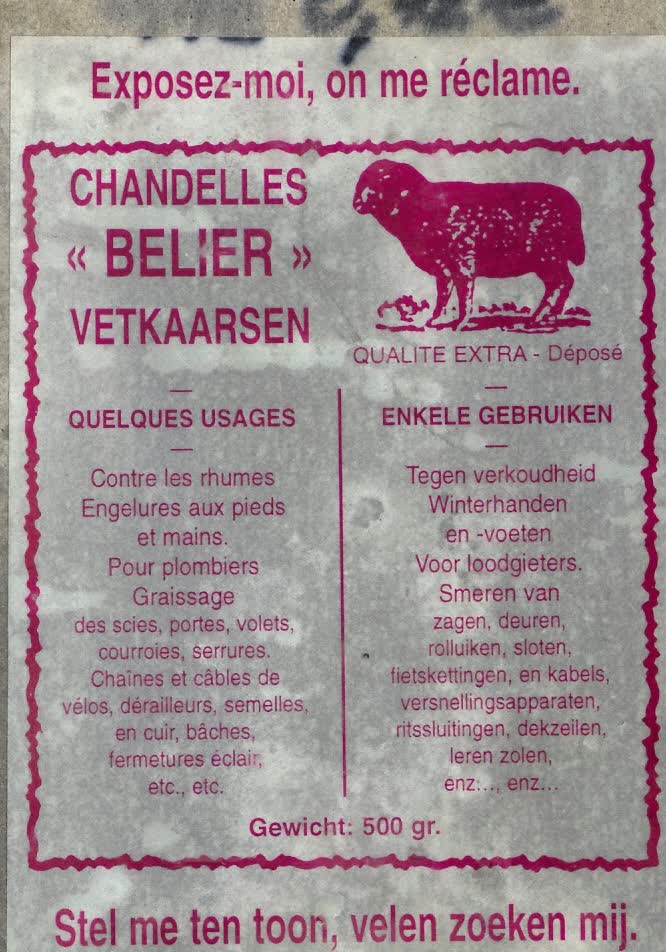
A tallow candle
It is a small candle of about twenty grams, made of a cotton wick coated in tallow. Tallow is the rendered fat of sheep or cattle. In the Middle Ages, it fuelled the candle of the poor, while pure beeswax lit the homes of the rich.
And that is exactly where its power lies.
Our ancestors prayed far more than we do. They left an “akashic” charge, a collective memory, in tallow and in pure beeswax. That is why wishes are granted so much faster.
Antoine de Saint-Christophe
The paraffin of our modern candles, on the other hand, is far too recent: it holds no egregore.
How to use it
- Keep your candle lying flat, wrapped in cellophane, in the fridge. For a quest for grace, the cellophane is essential: no one else must have soaked the tallow with their aura.
- Stand it upright on a base: a candlestick, a saucer. If it is handmade, give it a flat bottom with a blade.
- Light it and think hard about your wish for the whole time it burns.
- If you can't concentrate for that long, place a photograph of your face under the holder. An ordinary photo is enough, because this is about an egregore, not a radionic principle. But your face must appear on it alone.
- When it has burnt out, go to bed.
The candle gives off no smell. And the colour of its flame is often a sign of what is coming:
| Flame | Meaning |
|---|---|
| Yellow | Waiting |
| White | The path to fulfilment |
| Blue | Obtaining |
Antoine prepared the figurines with the berry of the tree of luck, and the Ram candles, for the rituals he performed. Write to the workshop about your wish for love.
Frequently asked questions
What is the tree of luck?
Clerodendrum, a tree from Asia with jasmine-scented flowers followed by blue berries. Its name comes from the Greek klêros, drawing lots, and dendron, tree.
What is a dagyde?
A wax figurine that represents a person, a couple, sometimes an animal or a house. In Antoine's ritual, it is made of pure capping wax, with a blue berry from the tree of luck at its heart.
What is the chessboard ritual for?
It is a variant of the Saint Ambrose ritual entirely devoted to love.

Free guide · Alchimixe GPS
Why Do I Keep Living the Same Love Story?
The faces change, the story starts over. It isn't a flaw: it's a pattern, and a pattern shows up in a chart.
Get the free guide