Look at the Moon tonight. Then look at it tomorrow night, at the same time.
It is no longer in the same place. It has moved about thirteen degrees east, roughly the width of your hand held out at arm’s length. Every night, it takes one step. In twenty-seven days and a few hours, it has gone all the way around the sky.
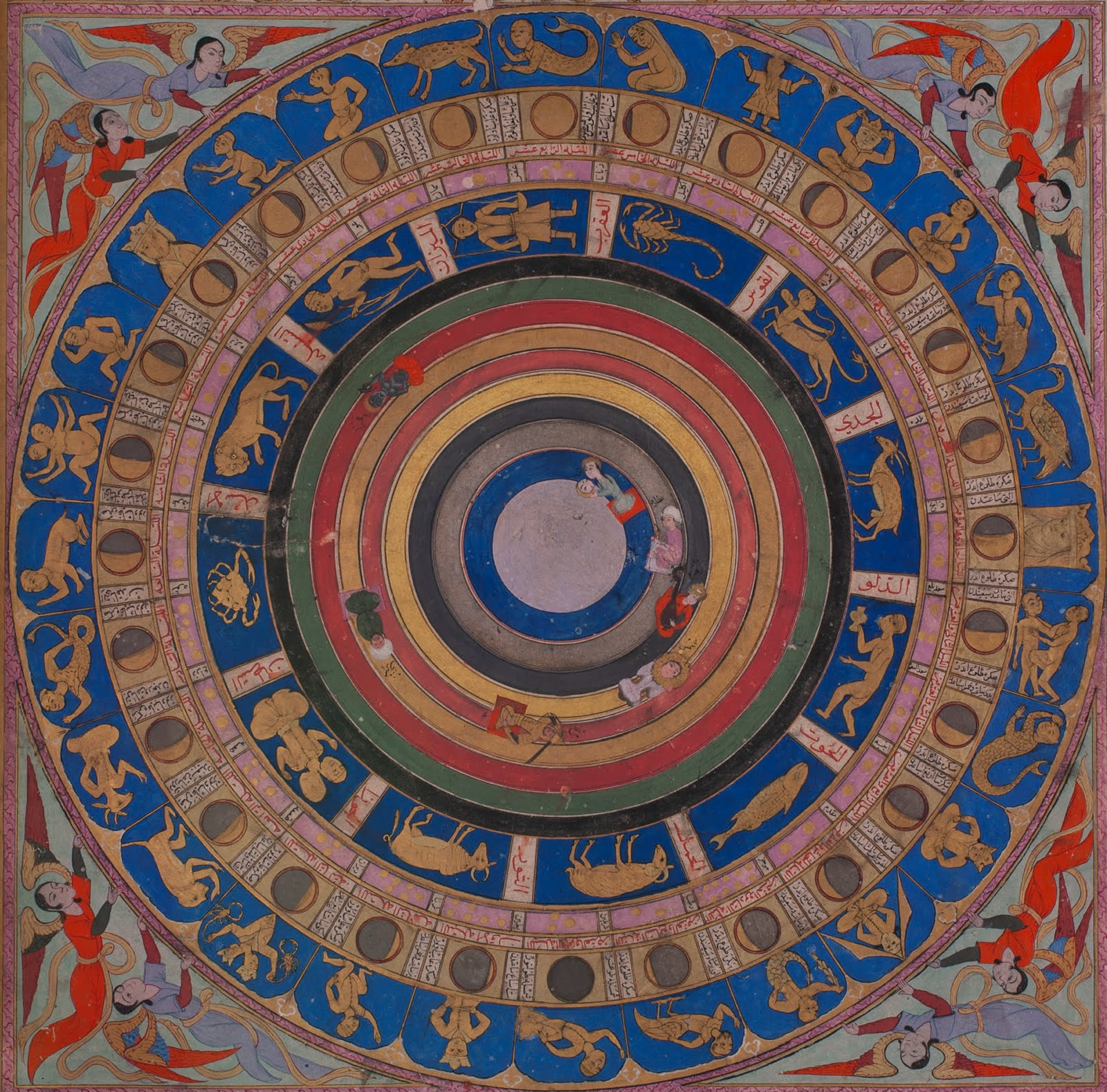
Ancient peoples, who lived under the stars far more than we do, noticed this rhythm. And they had an idea: if the Moon takes twenty-eight steps, then the sky has twenty-eight houses, one for each night. They called them the mansions of the Moon.
An idea born in India, grown in Arabia
The oldest trace of this system is found in India, in Vedic texts nearly three thousand years old. The Indians count twenty-seven, sometimes twenty-eight mansions: the nakshatras, which we discuss in Indian astrology.
The Arabs, for their part, have long known the manāzil al-qamar, the “stations of the Moon”. The Bedouins used them as a calendar: when such a star rises at dawn, it is the time of rain, or of the great heat, or of the caravans setting out.
In the Middle Ages, the scholars of Baghdad and Andalusia blended these traditions with Greek astrology. The twenty-eight mansions were then cut out evenly along the zodiac, starting from the beginning of Aries. Each one measures a little under thirteen degrees. And each one was given a character, with favorable and unfavorable uses.

The Picatrix and Agrippa
Two books carried the mansions all the way to Europe.
The first is the Picatrix, an Arabic treatise on astral magic written around the 11th century in Andalusia, under the title Ghāyat al-Ḥakīm, “The Goal of the Sage”. Translated into Latin at the court of Alfonso X of Castile, it circulated secretly throughout Europe. It describes, for each of the twenty-eight mansions, what is good to undertake there.
The second is the great treatise of Heinrich Cornelius Agrippa, Three Books of Occult Philosophy, published in 1533. Agrippa takes up the list of mansions and their virtues. Thanks to him, they entered the learned culture of the Renaissance.
According to these traditions, there are mansions for traveling, others for building, others for love and friendship, for trade, for learning, and others where it is better to start nothing at all.
Tradition calls some mansions unfavorable. We never use them to harm anyone: only to choose the good moments, and avoid the bad ones.
Tonight and at your birth
Here is the mansion where the Moon is today. Enter your birth details, and we calculate the one of your natal Moon.
For entertainment and self-reflection.
A few famous mansions
We won’t give you all twenty-eight meanings: those are kept for the readings. But here are a few, so you can feel the poetry of this system.
The Pleiades (Al-Thurayya), the third mansion. This small cluster of seven stars, which you can see with the naked eye in winter, is one of the best-loved mansions. Tradition held it to be favorable to travelers, sailors and alchemists. A mansion of prosperity.
The Ear of Wheat (Al-Simak), the fourteenth. It bears the name of the brightest star in Virgo, Spica. Tradition associates it with love between spouses and with faithfulness.
The luck of lucks (Sa‘d al-Su‘ud), the twenty-fourth. Its name says it all. In tradition, it is the mansion of goodwill, victory and prosperity. When we look for a date for someone, it is one of the first we check.
The belly of the fish (Batn al-Hut), the last. It closes the cycle, and tradition saw in it the safety of travelers and plenty in trade. A fine mansion to end on.

The mansion of your birth
Your natal Moon occupies one of these twenty-eight houses. In our practice, it says something important: the way you live your emotions and your needs, and the kind of moments when you feel most at ease.
A Moon born in the Pleiades doesn’t have the same sensitivity as a Moon born in the Heart of the Scorpion. One loves movement and horizons, the other depth and intensity.
And above all, every month, the Moon comes back to your mansion. For about a day, it passes again exactly where it was at your birth. We call it your lunar appointment. Many traditions recommend making a gesture, a request, or taking stock on that day. The dates come with the Club plan, in the calculator above.
Why these old mansions still speak
You might think all this belongs to the past. We think the opposite.
Modern life has cut the link with the rhythm of the Moon. We live under lamps, in front of screens, according to schedules that ignore the sky. The mansions of the Moon bring back a simple rhythm: twenty-eight nights, twenty-eight qualities. You don’t do everything, all the time. You choose.
And there is something we have noticed over twenty years: people who follow the Moon, even in a very simple way, end up sensing their own cycles better. The days when they have drive, the ones when they need calm. That is already a form of luck.
And now, you
- Look at tonight’s mansion, in the calculator above.
- Write down the one of your birth.
- Observe for a month how you feel on the days when the Moon comes back to your mansion.
And if you want its full meaning, the nights when the Moon returns to it, and the mansions that serve your projects, the workshop calculates them for you.
Frequently asked questions
What are the mansions of the Moon?
They are the twenty-eight divisions of the sky that the Moon crosses in a month, about one per night. Each one has a name and a meaning in the Arab, Indian and European traditions.
What is the difference with the nakshatras?
The nakshatras are the Indian version, twenty-seven of them, counted in the sidereal zodiac. The Arab and European mansions number twenty-eight, counted here from the beginning of Aries.
Where do the meanings of the mansions come from?
They were passed down notably by the Picatrix, an 11th-century Arabic treatise translated into Latin, and by Agrippa’s Occult Philosophy, published in 1533.
Do I need my time of birth to know my mansion?
It is better: the Moon moves about half a degree per hour. Without the time, the mansion is certain in most cases, but not always.
How long does the Moon stay in a mansion?
About a day, a little under twenty-four hours, since it goes around the sky in a little over twenty-seven days.