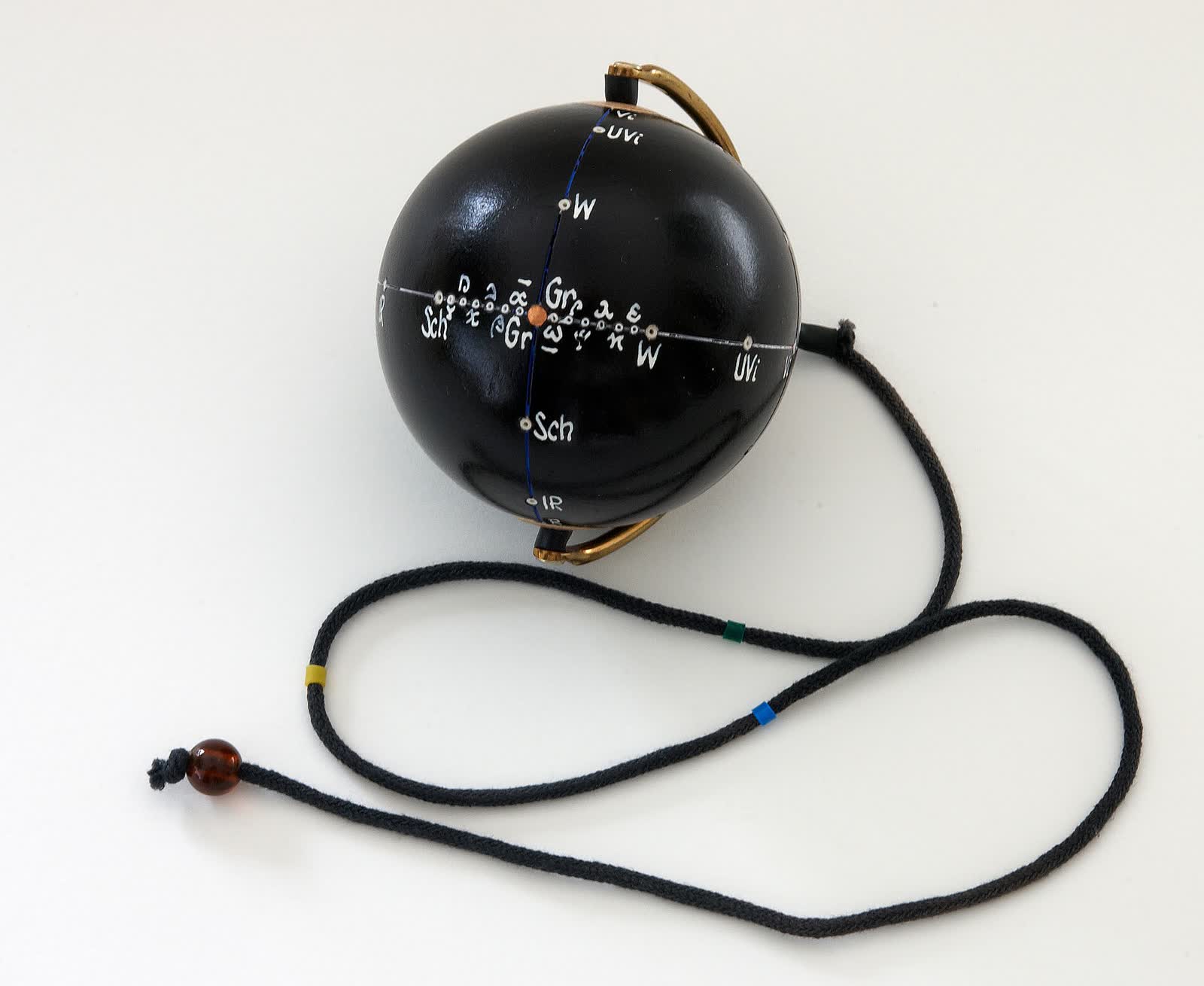
A string, a weight, a question
The pendulum is the simplest tool in dowsing. A slightly heavy object hanging from a little chain or a string, held between thumb and index finger. You let it hang, still. You ask a question. And you watch what it does: it swings back and forth, left and right, it turns one way or the other.
The French word for dowsing, radiesthésie, was coined by Abbé Alexis Bouly, a priest from northern France, from the Latin radius, ray, and the Greek aisthêsis, sensitivity. The practice itself is much older: water diviners were looking for water with a hazel rod long before anyone gave it a learned name.
In the workshop, the pendulum has two uses, described in The pendulum: to detect and to emit. Here, we stay with the first step: learning to hold it and listen to it.
Choosing your pendulum
There is no "best" pendulum. There is the one that suits you. A few pointers:
- Weight. Between 10 and 30 grams to begin with. Too light, and it reacts to the slightest breath; too heavy, and it tires your hand.
- Shape. A drop, a sphere, a cone: tradition likes symmetrical shapes, which turn evenly. Geometric shapes, like the five Platonic solids, have their fans.
- Material. Wood, brass, copper, stone. Wood and brass are neutral and sturdy. A stone can be beautiful, but it breaks if it falls.
- String length. From 10 to 20 centimetres. You will find your length by trying: wind the string around your finger until the movement feels clear.
The workshop's advice: hold the pendulum in your hand before choosing it. If it feels right in your hand, it's the right one.
Preparing your session
The pendulum asks for few things, but it really does ask for them.
- A calm moment. Not between two appointments. Ten minutes when nobody interrupts you.
- A stable posture. Seated, feet flat, elbow resting on the table. Your arm should not float.
- A relaxed hand. The string between thumb and index finger, the other fingers loose. Don't grip.
- A neutral mind. This is the hardest part. If you badly want an answer, the pendulum will give it to you, and it will be worthless. More on this below.
Some practitioners "cleanse" their pendulum before starting, by running it under clear water or leaving it for a few minutes on a stand. It is a traditional gesture, a way of marking the start of the session. Above all, it helps the person doing it to settle.
Finding your yes and your no
This is the first thing to do, and you do it again every time. Everyone has their own conventions: for one person, "yes" is a clockwise rotation; for another, it's a back-and-forth swing.
The exercise:
- Hold the pendulum still above the table.
- Say out loud, or in your head: "Show me my yes." Wait. Let the movement come, without looking for it.
- Stop the pendulum with your other hand. Then: "Show me my no."
- Write both movements down on a sheet of paper.
- Check with questions you know the answer to: "Is my name [your first name]?", "Is it winter?"
If the pendulum doesn't move, it doesn't matter. It is even common the first time. Try again the next day. The movement often comes as you relax.
You can also decide your conventions yourself: "Turning right will be my yes." Tradition accepts both ways.
How to ask a good question
The quality of the answer depends on the quality of the question. Here are the rules every dowsing manual gives, and which the workshop makes its own:
- One idea per question. Not "Should I leave in March and sell the house?", but two separate questions.
- A closed question. The pendulum answers yes, no, or nothing. For multiple choices, use a board (see below).
- A clear question, in the present or about a fact. "Is this book the right one to start with?" rather than "What is going to happen to me?".
- No question whose answer you desperately want. When your heart gets involved, so does your hand.
- Stop when you are tired. After twenty minutes, the answers become blurred.
And write everything down. A pendulum notebook, with the date, the question and the answer, lets you read back later what was confirmed and what wasn't. It is the best school there is.
The yes/no board
A board is a sheet of paper on which you have drawn a fan or a circle divided into sectors. You hold the pendulum above the centre and watch which sector it swings towards.
The simplest is the yes/no board: a semicircle with "no" on the left, "yes" on the right, and in the middle "rephrase the question" or "no answer". That middle sector is essential: it reminds you that the pendulum doesn't have to answer.
There are also boards with numbers (from 0 to 10, to rate something), letters, colours, days of the week. They are easy to make: a protractor, a ruler, a pencil.
Why the pendulum moves: the Chevreul effect
This is the question everyone asks. The best-established answer is nearly two centuries old.
In 1833, the French chemist Michel-Eugène Chevreul, a great scientist of fats and colours, published a letter to his friend Ampère about the "exploring pendulum". He had tried the experiment himself. He noticed that the pendulum moved when he thought about the movement, and stopped when he was blindfolded or when he rested his arm on a support. In 1854, he devoted a whole book to it: De la baguette divinatoire, du pendule dit explorateur et des tables tournantes ("On the divining rod, the so-called exploring pendulum and turning tables").
His conclusion: tiny, involuntary muscle movements set the pendulum going. You don't feel them. You don't decide them. But they exist. In 1852, the English physiologist William Carpenter gave them a name: the ideomotor effect. The idea of a movement is enough to produce the beginning of a movement.
Should we conclude that the pendulum is useless? Tradition answers differently. If the pendulum amplifies what the body already knows without saying it, then it becomes a tool for listening to yourself: a way of making visible an intuition, a hesitation, a preference you hadn't put into words. That is how the workshop presents it: not as an oracle that knows in your place, but as a mirror of what you perceive.
This reading has a practical consequence, and it matches the rules of the previous section: the more neutral you are, the more the pendulum tells you about yourself; the more you want an answer, the more it gives it to you, and the less it is worth.
What you never ask a pendulum
This is the most important part of this article.
- Nothing about health. No diagnosis, no choice of treatment, no dosage. The pendulum never replaces a doctor, and the workshop does not use it in this area.
- No medical, legal or financial decisions. A contract, an investment, a lawsuit are decided with professionals.
- Nothing about other people without their consent. You don't probe the feelings, intentions or life of someone who hasn't asked for it.
- No games of chance. The pendulum does not pick numbers for a draw. No gesture changes the randomness of a draw.
- No question that frightens you. If the answer might make you anxious, don't ask the pendulum. Talk to someone about it.
For everything else, finding an object mislaid somewhere in the house, choosing between two books, sensing the right moment for a personal step, it is a modest and telling companion.
To go further
Once you have found your yes and your no, dowsing opens up: shapes, waves, supports. The workshop has written pages on the dowsing pile, on the Star of Brahma and on shape waves. The whole section is in Dowsing.
Frequently asked questions
How do I use a pendulum for the first time?
Sit down, elbow resting, string between thumb and index finger. Ask the pendulum to show you your "yes", then your "no", and write down both movements. Check with questions you know the answer to. If it doesn't move, try again another day, more relaxed.
Which pendulum should a beginner choose?
A simple, symmetrical pendulum of 10 to 30 grams, in wood or brass. The shape matters less than how it feels in your hand.
Is a divination pendulum reliable?
It does not predict the future. Since Chevreul's work (1833, 1854), we know its movements come from involuntary micro-movements of the hand. Tradition uses it as a tool for listening to yourself, not as a source of outside truth.
Can a pendulum be used for health?
No. The pendulum makes no diagnosis and chooses no treatment. For any health question, see a doctor.
What is a pendulum board?
A sheet divided into sectors (yes, no, numbers, letters) above which you hold the pendulum. The yes/no board always includes a "no answer" box.