An equation for me has no meaning unless it expresses a thought of God.
Words attributed to Srinivasa Ramanujan
Some people learn numbers. And a very rare few seem to have numbers speak to them on their own.
Srinivasa Ramanujan was one of them. He had almost no higher education. He had no teacher. He filled whole notebooks with formulas he said came to him in his sleep. And those formulas are still being studied by mathematicians all over the world today.
A magic square bears his name. It is the one Antoine chose for one of his models: the Ramanujan vestibule square.
The man who knew infinity
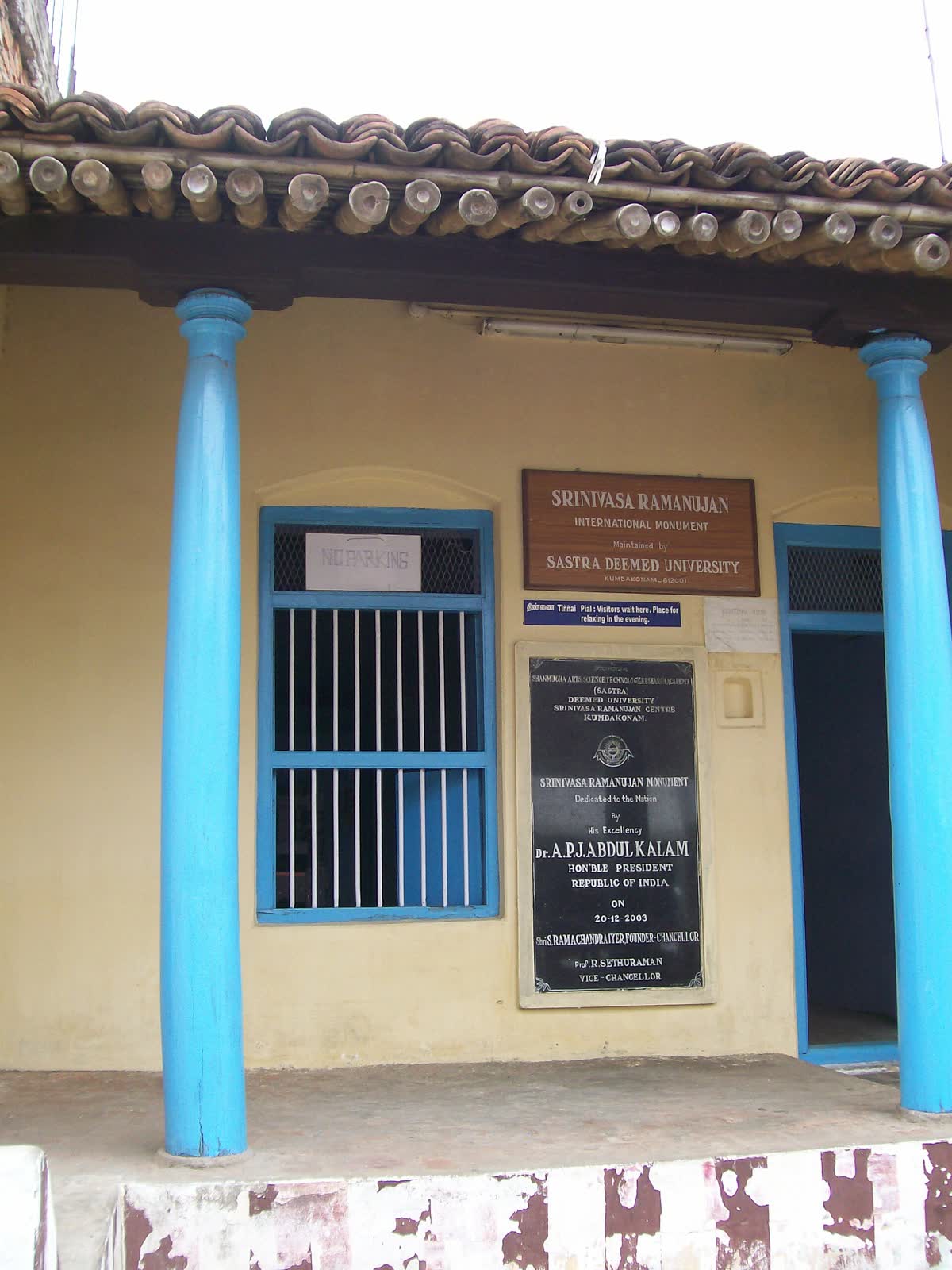
Ramanujan was born on December 22, 1887 in Erode, in southern India, and grew up in Kumbakonam, a temple town of the Tamil country. His family was poor. At school he devoured an old collection of mathematical formulas, and began to find new ones, alone, without knowing how to prove them.
He failed his exams, because mathematics was all he cared about. In the end he found a job as a humble clerk at the port of Madras.
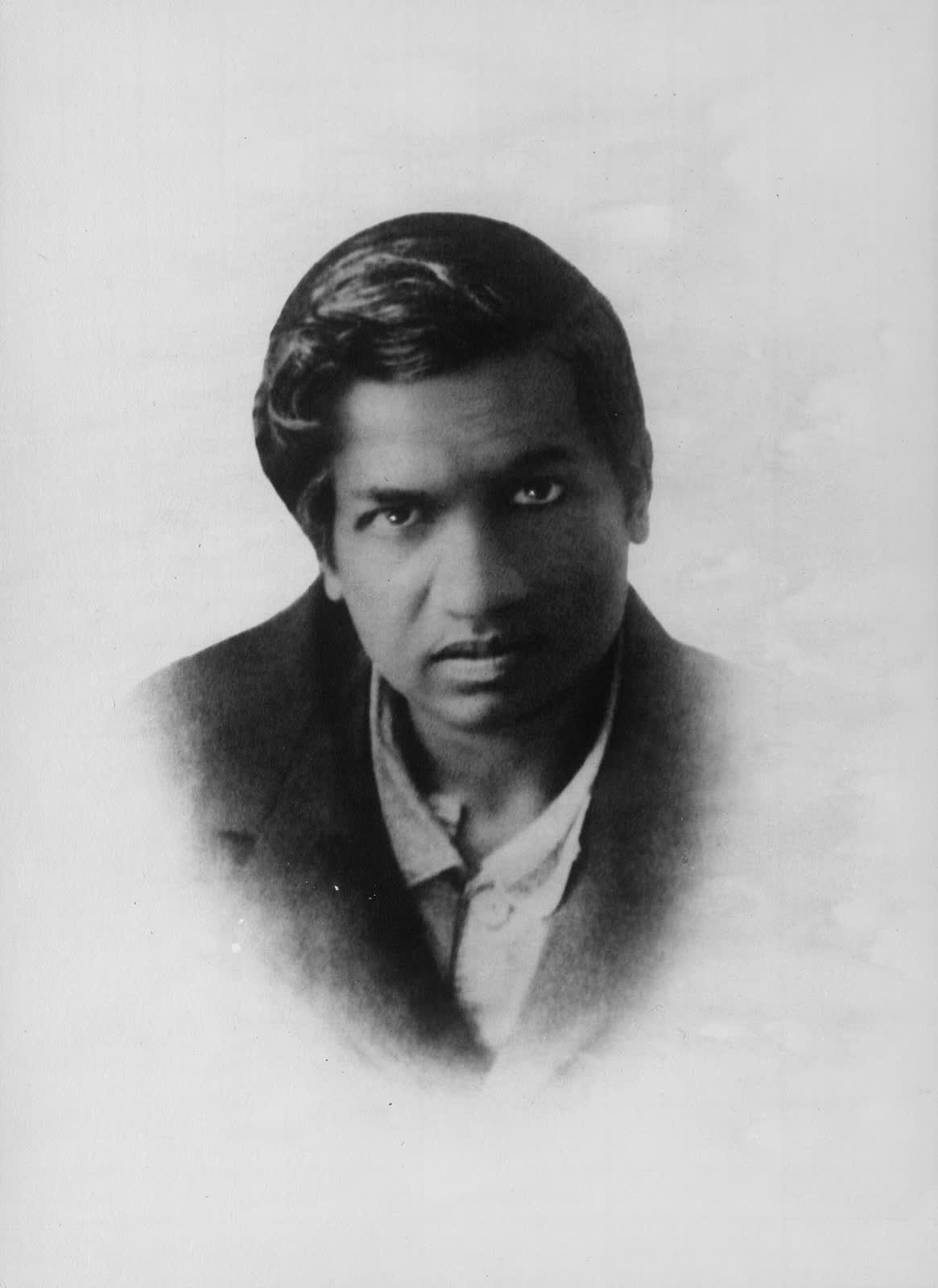
In 1913, he made a decision that would change his life. He wrote to a Cambridge mathematician, Godfrey Harold Hardy, and enclosed whole pages of formulas. Hardy read them, incredulous at first. Then he understood: some of these formulas, he later wrote, were like nothing he had ever seen. They could only come from a mathematician of the very highest class.
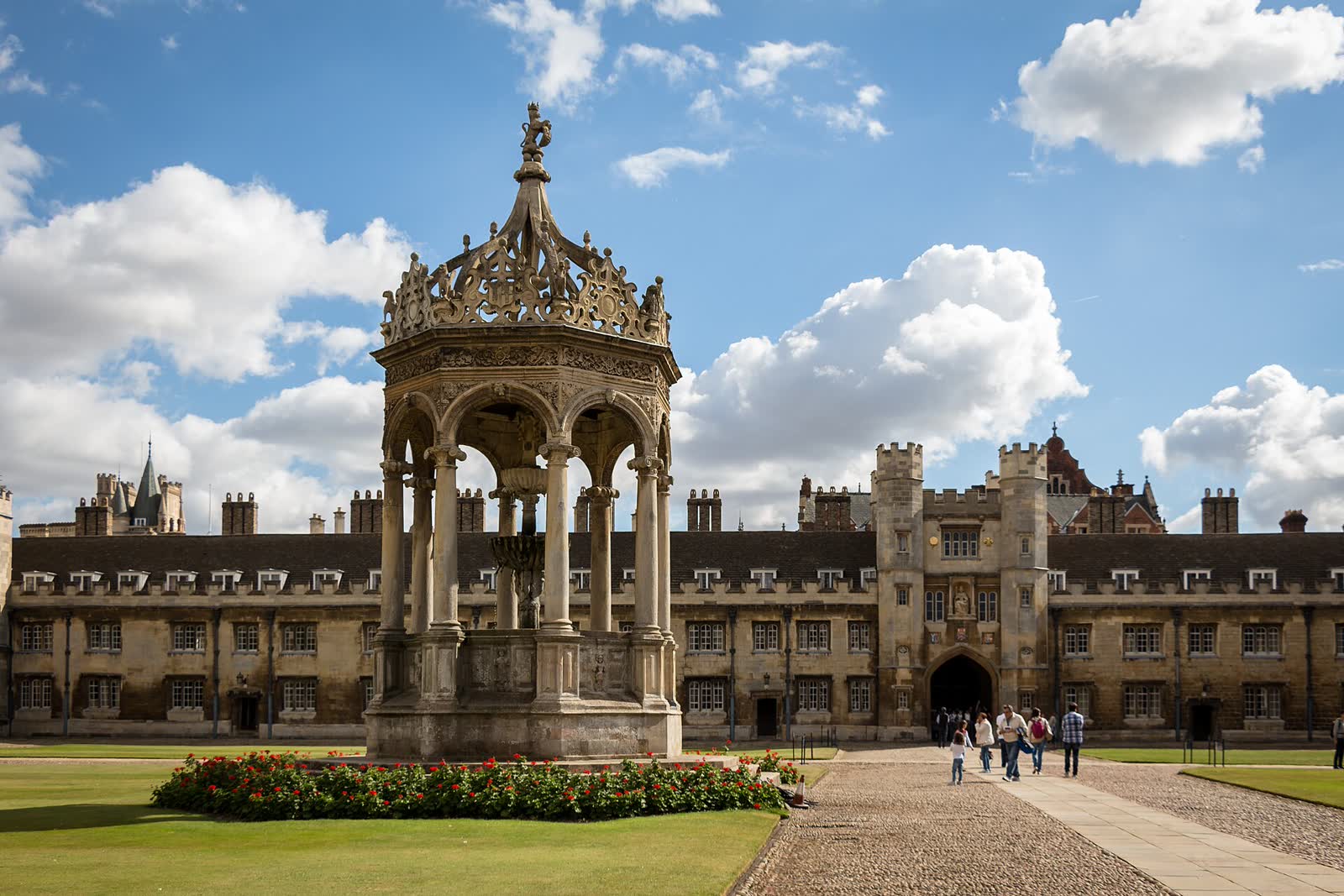
In 1914, Ramanujan left India for England. He entered Trinity College, Cambridge. Within a few years he published landmark work, and was elected a Fellow of the Royal Society, one of the highest scientific honours in the world.
The number 1729
One anecdote has become famous. Hardy visits Ramanujan, who is ill, and tells him he came in a taxi with a rather dull number: 1729.
Ramanujan immediately replies that no: 1729 is a very interesting number. It is the smallest number that can be written as the sum of two cubes in two different ways.
1729 = 1³ + 12³ = 9³ + 10³.
Since then it has been called the Hardy-Ramanujan number. For Antoine, this story says it all: where others see a taxi number, some see an architecture.
1 + 7 + 2 + 9 = 19, then 1 + 9 = 10, then 1 + 0 = 1. The Hardy-Ramanujan number has channel 1, the universal channel, the channel of the square of the Earth.
A life too short
The English climate, the war, the strict vegetarian diet he could not keep up in England: Ramanujan fell seriously ill. He went back to India in 1919, and died the following year, on April 26, 1920, aged thirty-two.
He left behind notebooks filled with thousands of formulas. Some were only understood decades later. His story was brought to the screen in 2015 in the film The Man Who Knew Infinity.
The square of his birth
The square that bears his name is built from his birth date. On the first row, you write the day, the month, then the year cut in two: 22, 12, 18, 87.
The twelve other cells follow by adding or subtracting 1, 2 or 3:
| 22 | 12 | 18 | 87 |
|---|---|---|---|
| 88 | 17 | 9 | 25 |
| 10 | 24 | 89 | 16 |
| 19 | 86 | 23 | 11 |
Add up the first row: 22 + 12 + 18 + 87 = 139. The first column: 22 + 88 + 10 + 19 = 139. The main diagonal: 22 + 17 + 89 + 11 = 139. The other diagonal: 87 + 9 + 24 + 19 = 139. The four corners: 22 + 87 + 19 + 11 = 139. The four centre cells: 17 + 9 + 24 + 89 = 139.
The same number everywhere. The vortex of the Ramanujan square is 139. Its channel: 1 + 3 + 9 = 13, then 1 + 3 = 4.
The formula
Here is how the square unfolds, for any date. DD is the day, MM the month, CC the first two digits of the year, YY the last two.
| DD | MM | CC | YY |
|---|---|---|---|
| YY+1 | CC−1 | MM−3 | DD+3 |
| MM−2 | DD+2 | YY+2 | CC−2 |
| CC+1 | YY−1 | DD+1 | MM−1 |
You will recognise the same idea as in your personal magic square, built with Asker Ali Abiyev's formula: the same first row, the same small gaps. But the cells are not arranged the same way.
Two squares for the same date
This is what Antoine showed in his research sheets. He took one date, June 15, 1972, and built the two squares side by side.
The Ramanujan square:
| 15 | 6 | 19 | 72 |
|---|---|---|---|
| 73 | 18 | 3 | 18 |
| 4 | 17 | 74 | 17 |
| 20 | 71 | 16 | 5 |
The Abiyev square:
| 15 | 6 | 19 | 72 |
|---|---|---|---|
| 20 | 71 | 16 | 5 |
| 70 | 17 | 8 | 17 |
| 7 | 18 | 69 | 18 |
Same first row. Same vortex, 112, in every direction. Same channel, 4. But two different paths to get there: the numbers are not quite the same, and they are not in the same place. Two doors into the same house.
Your two squares: Ramanujan and Abiyev
Calculated in your browser: nothing is sent. For entertainment and self-reflection.
The vestibule model
That leaves the word Antoine attached to this square: vestibule.
Antoine separates squares into two families, which are never mixed. The closed-grid square, where each cell is surrounded by a line: energy circulates in a loop, as in a closed circuit. And the vestibule square, where the cells alternate black and white, like the tiled floor of an entrance hall.
The vestibule is the room you come in through. A vestibule square is an open square: its form effect radiates outwards, through its edges.
In Antoine's model, the Ramanujan square sits in the centre of its vestibule, and its vortex is written in the four corners. For June 15, 1972, you therefore read 112 four times around the square: four guardians of the same number, one at each corner.
Antoine had also prepared a neutral vestibule model, built the same way with Abiyev's formula. The principle doesn't change: your date in the centre, your vortex in the four corners.
Marking the Buddha Foot
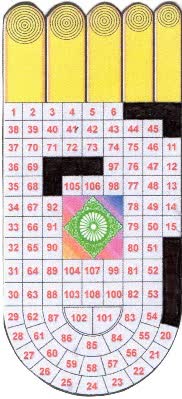
The vestibule square has a second life: it can mark a Buddha Foot. The white face of the Foot is covered with small numbered cells, which form the first twelve octaves, from 1 to 108. You find the numbers of your square on it.
Antoine gave two ways to do it:
- With stickers: enlarge the image of the Foot, and put a small round adhesive sticker on each number that is part of your square.
- By piercing: get a Buddha Foot in the paperweight model, and pierce each number that makes up your square.
And he added four rules:
- Zero is not shown on the Buddha Foot.
- A repeated number is stuck or pierced only once, in its cell.
- A number above 108 is reduced only once: 124 becomes 1 + 2 + 4 = 7.
- A number within the first twelve octaves is never reduced.
For the Ramanujan square, for example, you would mark 9, 10, 11, 12, 16, 17, 18, 19, 22, 23, 24, 25, 86, 87, 88 and 89: all within the twelve octaves, none to reduce.
Between the mirror and the flame
The second option, the pierced Foot, has an advantage Antoine liked to point out: you can place it between an infinity mirror and a light source, ideally a natural one, like an Aries candle. The personalised form effect, he wrote, is then amplified to infinity, sent back from reflection to reflection.
He also advised placing your personal square in front of an infinity mirror without LEDs, or better still, in a small Kozyrev-type mirror, named after the Russian astrophysicist Nikolai Kozyrev, whose concave mirrors became famous in circles researching time.
What Ramanujan leaves us
A clerk who writes to Cambridge. A taxi number that becomes a law. A birth date that becomes a perfect square.
For Antoine, Ramanujan is living proof of what he has taught for forty years: numbers are not cold. They have an architecture, a beauty, a voice. You just have to know how to listen.
Build your Ramanujan square. Add up its rows. Watch the same number come back, again and again. It is yours.
Would you like your Ramanujan vestibule square, printed with your vortex in the four corners, or your marked Buddha Foot? Send your birth date to the workshop.
Frequently asked questions
Who was Ramanujan?
Srinivasa Ramanujan, an almost self-taught Indian mathematician, born on December 22, 1887 and died on April 26, 1920. Spotted by Godfrey Harold Hardy, he joined Trinity College, Cambridge, in 1914, and was elected a Fellow of the Royal Society.
How do I build the Ramanujan square?
On the first row, your day, your month, then your year cut in two. The twelve other cells follow by small gaps of 1, 2 or 3, using the formula given in the article. The calculator does it for you.
How is it different from the Abiyev square?
The same date gives the same first row and the same total, but the numbers and their places change. They are two different paths to the same vortex.
What is a vestibule square?
An open square whose cells alternate black and white, like the tiled floor of an entrance. In Antoine's model, the square's vortex is written in its four corners.
How do I mark a Buddha Foot with my square?
By finding each number of the square on the white face of the Foot, with a sticker or by piercing it. Zero is not shown, a repeated number is marked only once, and a number above 108 is reduced only once.

Free guide · Luck
Stack the Odds in Your Favor: a bad patch has a shape, and a calendar to get out of it. Our short guide, free by email.
Get the free guide →