Nothing is new except what has been forgotten.
Antoine de Saint-Christophe
This is the sentence Antoine opens his text on the Buddha Foot with. And it has never been truer.
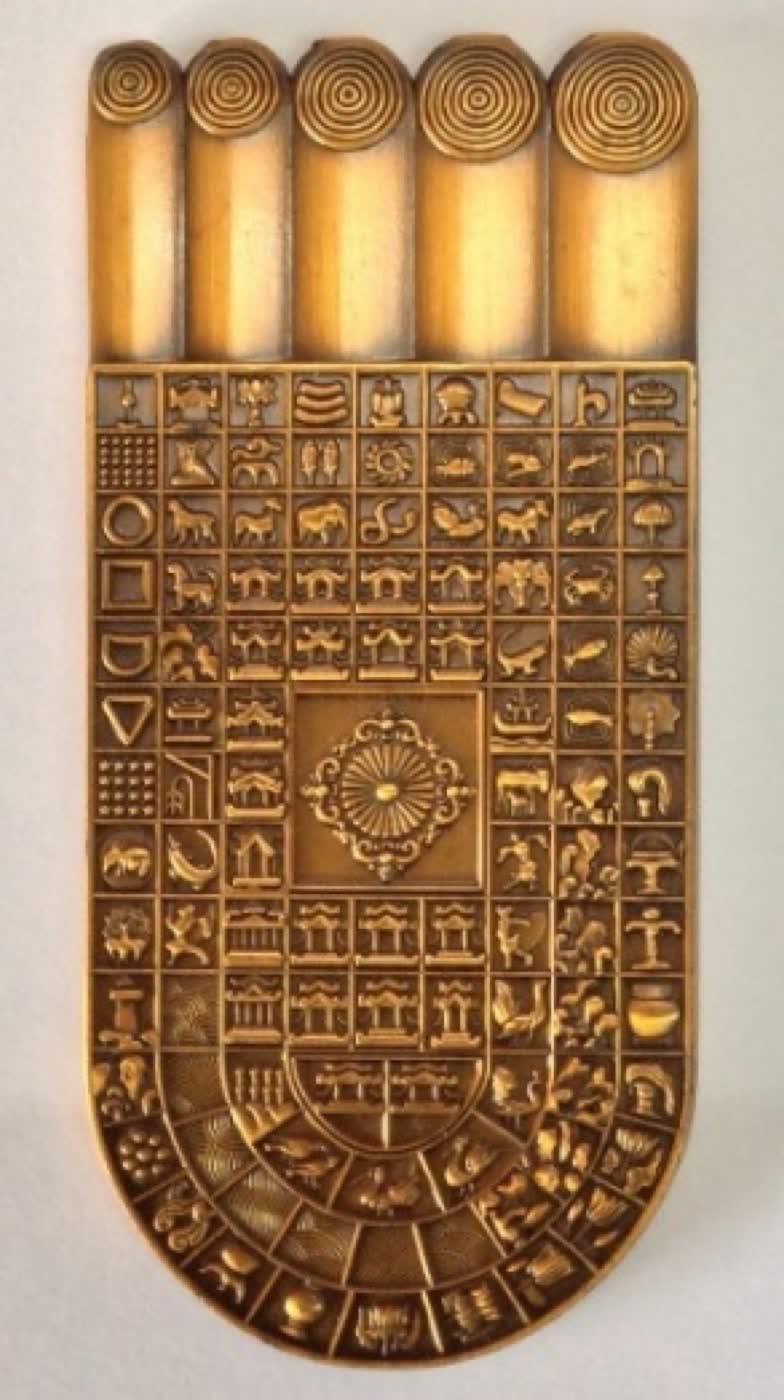
The object we are going to talk about is more than two thousand years old. You find it carved in the stone of Asian temples, from India to Japan: the footprints of the Buddha, covered with symbols, which pilgrims have come to touch for centuries. For the faithful, it is the trace he left on the earth. The sign that he passed this way, and that you can walk in his steps.
In imperial China, the nobility turned it into a talisman. A small metal footprint, worn on the body or hung in the house. Antoine considers it the most powerful good-luck charm in the world, because it brings together all the symbolism of the Buddha's body and all the elements of the universe.
The first step
Before talking about squares, chains and trees, Antoine recalls the deeper meaning of this object.
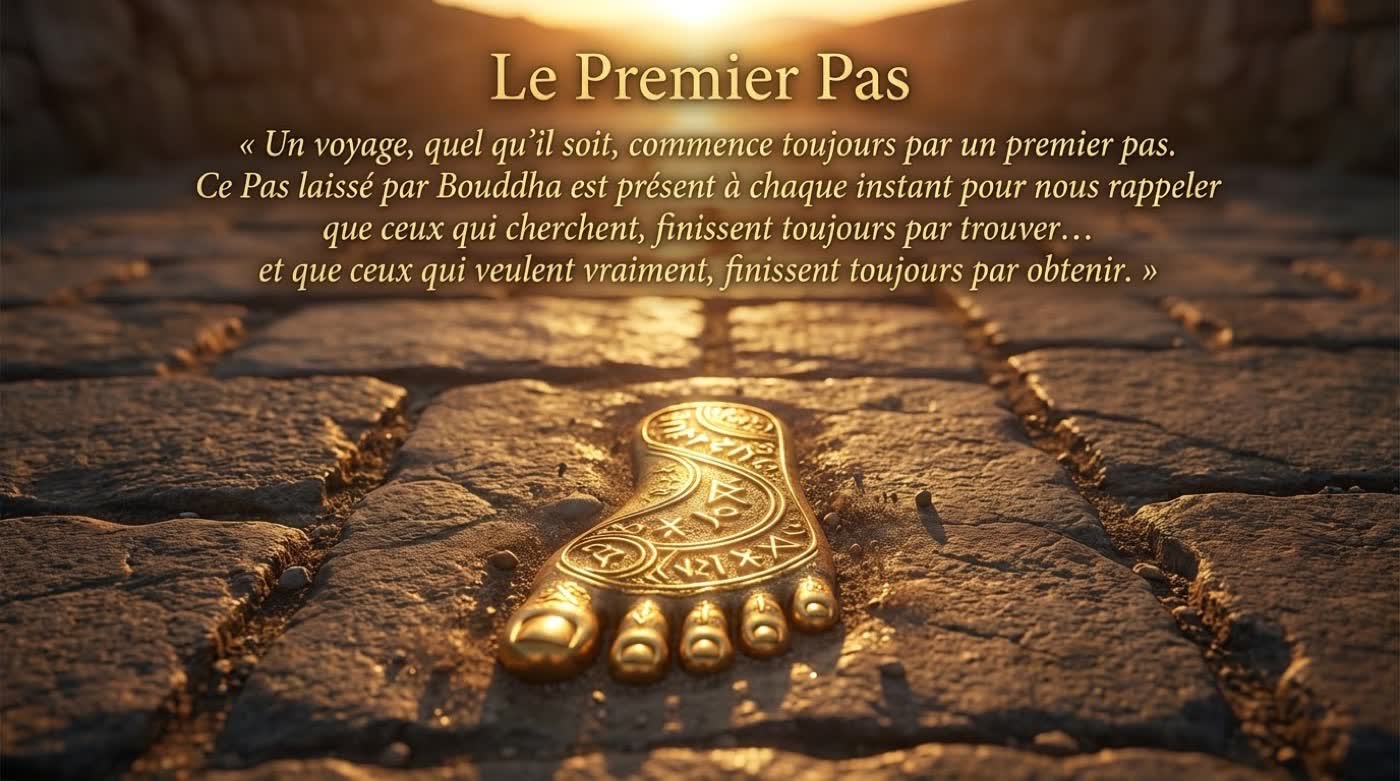
A journey, whatever it is, always begins with a first step. That is exactly what the footprint represents: the step left by the Buddha, present at every moment to remind us of two things.
Those who seek always end up finding. Those who truly want always end up obtaining.
Antoine de Saint-Christophe
The object
The Buddha Foot Antoine uses can be described precisely:
- Solid brass, 90 grams, 108 millimetres high with its ring, 46 millimetres wide.
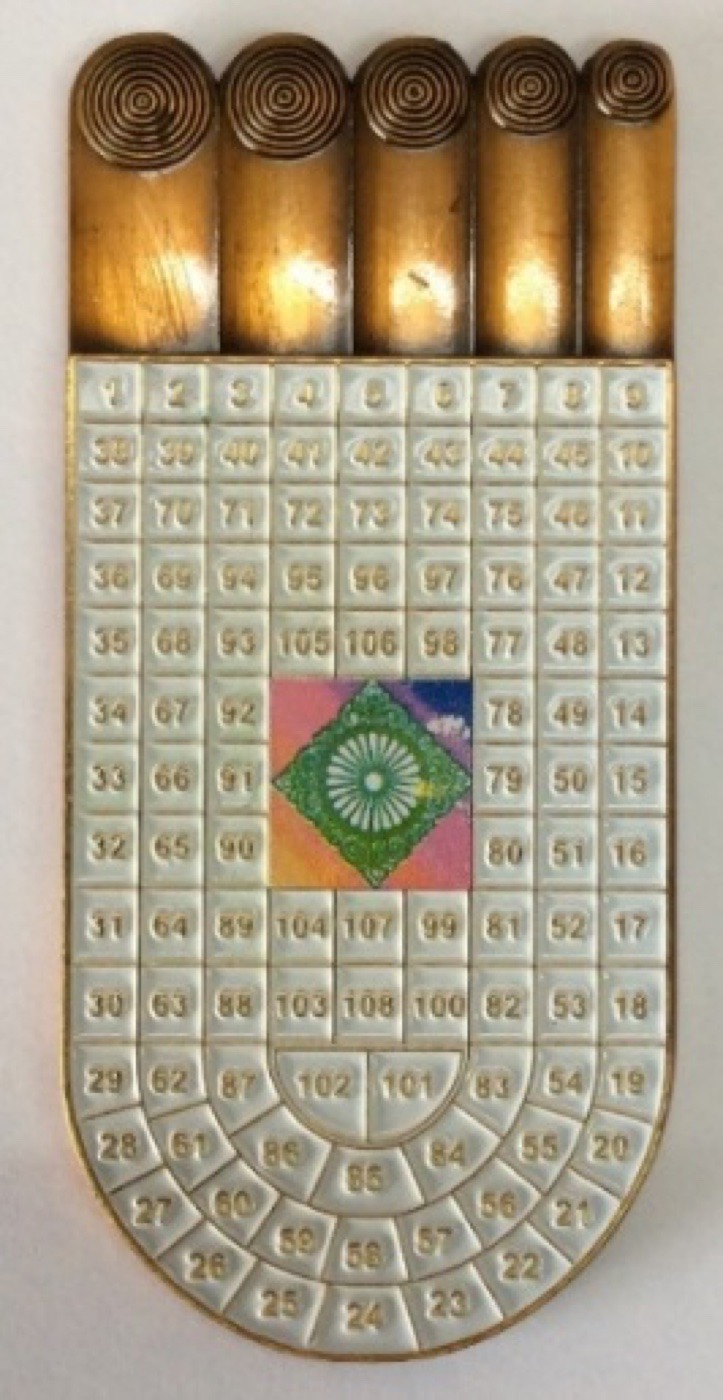
- Two faces: the symbolic face, bronze-coloured, covered with sacred signs; and the numeric face, in a white he calls pentatonic, ruled into cells.
- In the centre, the wheel of life, green on an orange ground.
- A chain of 108 beads of black brass, 3.2 millimetres each, 48 centimetres long: 4 + 8 = 12, 1 + 2 = 3, the principle of three.
It also exists in solid 18-carat yellow gold and in silver. And Antoine notes that it vibrates at the top of the Bovis scale, the measuring scale of dowsers.
Three ways to wear it
This is the tradition of imperial China that Antoine rediscovered. It fits in one sentence:
To help your neighbour is to wear a Buddha Foot marked for your neighbour, or to hang it on a tree of a thousand powers.
Tradition of imperial China
Hence three ways to use it:
Unmarked, it will be your guide and protector throughout your life. As it is, it is already beneficial in every case, Antoine writes, because it goes beyond our physical space-time.
Marked with your square, your personal imprint, it becomes your guide and protector, and can also be placed on a ficus ginseng.
Marked with another person's square, it makes you that person's guide and protector: a child, a parent, someone going through a hard time.
The marking
Here is the heart of the knowledge. The white face of the Buddha Foot is covered with small cells that form a path. This path covers what Antoine calls the first twelve octaves. A code is written on it.
Antoine set out the marking rules in his square models: see the Ramanujan square and the Kubera Kolam.
Antoine knows four ways to code a Buddha Foot:
- with the Lo Shu square, the square of the nine halls of ancient China;
- with Asker Ali Abiyev's personal square, built on your birth date;
- with the wheel of Pythagoras, which reveals your life line;
- with the Cagliostro technique, which he finds intriguing in more ways than one.
How to mark it
Antoine gives the method for the personal square:
- With a permanent marker, cover on the path of the white face all the numbers that make up the square. No need to reduce them: the path already covers the twelve octaves.
- Use black and gold if you can, the two colours best suited to this marking, which he calls sacred.
- Absolute rule: never pierce a cell. A pierced cell would be a “wound”, and the talisman would no longer work, or would work badly.
How to wear it
Once coded, the Buddha Foot hangs from the neck on its chain of 108 beads: bronze face against the solar plexus, white face outwards.
You wear it for at least 9 days and at most 108 days. Afterwards, you can hang it facing an infinity mirror, or on a ficus ginseng.
Bipolarity
The nobles of ancient China knew a principle Antoine calls bipolarity. They wore their talismans in pairs: one in front, on the chest; one behind, on the back.
- An Om in front, a Lo Shu behind.
- A Buddha Foot in front, a Lo Shu behind.
- Or a Buddha Foot on each side.
They applied the same principle to their homes, for their own well-being or that of their loved ones.
The tree of a thousand powers
In China, it is very common to see Buddha Feet hanging from one particular tree: the ficus ginseng. A tradition that has carried on in wealthy families, Antoine notes mischievously, and among many centenarians.
You recognise the ficus ginseng by its bulb-shaped roots, which rise out of the soil like a small green planet carrying a wise and solitary tree. Antoine calls it the sacred tree of a thousand virtues.
Speak to the earth, and it shall teach thee.
Job 12:8
What the ficus ginseng does
Antoine recalls that the qualities of certain houseplants were highlighted by the researcher William Wolverton, for NASA: the ficus ginseng helps clean the air in the house. And for Antoine, it greatly raises the energy quality of the whole room, by harmonising the flow of chi, the vital energy of feng shui.
What's more, it amplifies the codes placed near it: runic codes, numeric codes, sacred writings. That is why the coded Buddha Foot is hung on it.
The ficus ritual
Antoine gathered the gestures that go with the tree:
- A film photograph of the person concerned is placed on the pot.
- The Lo Shu sign is written on the pot.
- The person's name is said out loud when watering.
- The coded Buddha Foot always hangs on its chain of 108 beads.
- Small rock crystals are buried in the compost or laid out symmetrically on its surface.
- The pot is ideally shaped like a Buddha's head, or octagonal like the Pa-Kua, in black or white.
- The mantra Om mani padme hum, played regularly, makes the leaves shinier: the ficus is very sensitive to sound.
Whoever unlocks the mystery of sound will unlock the mystery of the universe.
Money Zen
Antoine loves to describe what you see in Asia. In Japan and Macao, there are countless Maneki-neko, the lucky cats that raise a paw, and fortune pots placed at the foot of a ficus ginseng. In Hong Kong, many shopkeepers say they have never had an unpaid bill or the slightest dispute since they put their ficus next to their fortune pot. This is called Money Zen.
In Beijing, diviners lay the I Ching cards at the foot of a ficus ginseng so that they “speak” better. In Taiwan, divination cards are scattered there before use. And everywhere, people like to place it in the wealth corner of the house, according to feng shui. Set near a fountain of moving water, it is said to draw customers into shops.
The secret of the three stars
One last secret remains, from imperial China. At the foot of the ficus, you place in a triangle the three Chinese deities of happiness, the three stars:
- Fuxing, the star of happiness and good fortune;
- Luxing, the star of honours, wealth and power;
- Shouxing, the star of longevity.
Antoine adds that they are scented with wintergreen essential oil.
Looking after your ficus
A tree of a thousand powers is still a tree. Antoine gives a gardener's advice:
- Protect it from cold and draughts while moving it.
- Put it in the light, but never in full sun, nor above a radiator. Above 12 °C, it can spend the summer outside.
- It often loses a few leaves in the weeks after it arrives: this is normal.
- Water in moderation, a little more when it is hot.
- Mist its leaves with a little water every day.
- A little fertiliser every other month, in spring and summer only.
- Trim the shoots in spring and summer.
- Repot about every three years, when the roots come out of the pot.
Inseparable
The uses of the Buddha Foot are countless, Antoine writes. But one thing jumps out as soon as you study them: the Buddha Foot and magic squares are almost inseparable. One gives the shape, the other the code. You also find it at the heart of the Commodore, where its two faces carry the person's square and the square of their wish.
A first step, left two thousand years ago. A footprint you wear over your heart. And a code that belongs to you alone.
Tell the workshop who your Buddha Foot is for, you or a loved one, and send that person's birth date: we calculate the square and prepare the marking.
Frequently asked questions
What does the Buddha Foot represent?
The imprint of the first step, the one that begins every journey. Antoine's is in solid brass, with two faces: a symbolic face covered with sacred signs, and a numeric face on which a code is written.
How do you use the Buddha Foot?
In three ways, according to the tradition of imperial China: unmarked, as a guide and protector; marked with your personal square; or marked with another person's square, to become their guide and protector.
Why hang it on a ficus ginseng?
It is a Chinese tradition carried on in wealthy families. Antoine calls the ficus ginseng the sacred tree of a thousand virtues, and gives a gardener's advice in the article for looking after it.
Free guide · Luck
Stack the Odds in Your Favor: a bad patch has a shape, and a calendar to get out of it. Our short guide, free by email.
Get the free guide →