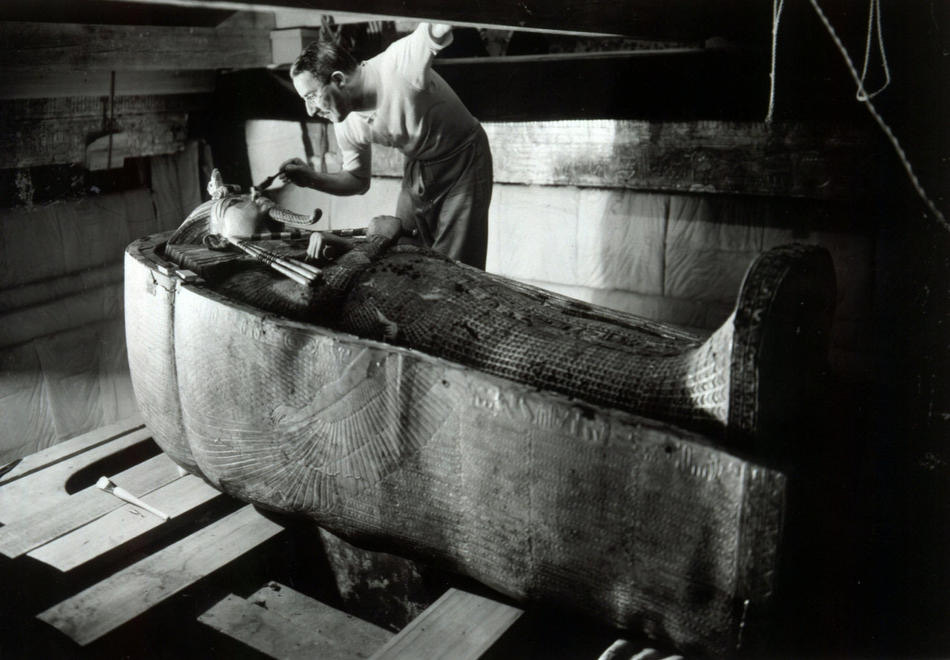
Death shall touch with its wings whoever disturbs the eternity of the pharaoh who rests in this place.
Inscription attributed to the door of Tutankhamun's tomb

This is the sentence that opens the old leaflet of the Atlantean ring, the one Antoine de Saint-Christophe kept in his archives. A sentence copied by newspapers all over the world in the 1920s. A sentence that made generations of readers tremble.
And this is where our story begins.
Thirty-five centuries of silence
Picture the Valley of the Kings, on the west bank of the Nile, opposite Luxor. A sun-scorched limestone mountain shaped like a natural pyramid. Beneath it, cut into the rock, the tombs of the pharaohs of the New Kingdom.
More than three thousand years ago, a last priest says his last prayer there. The doors of a young king's tomb are sealed. The torch flame goes out before Anubis, the jackal-headed god, guardian of the dead. And for thirty-five centuries, nothing, absolutely nothing, disturbs the rest of Tutankhamun, Lord of the Two Lands, son of Ra.
The tomb robbers, who emptied almost every tomb in the valley, walk right past his without seeing it.
Then comes the 20th century.
The glow of a candle
In November 1922, after years of fruitless digging, the English archaeologist Howard Carter finds a step cut into the rock. Then sixteen steps. Then a sealed door, intact. His patron, Lord Carnarvon, rushes over from England.
Carter makes a small hole in the door and holds up a candle. Behind him, Carnarvon grows impatient: “Can you see anything?” And Carter, dazzled, replies with words that became famous: “Yes, wonderful things.”
Gold. Gold everywhere. Statues, chariots, funeral beds, chests. And at the heart of the tomb, the royal burial chamber. In February 1924, the lid of the sarcophagus is finally lifted. Inside, nested like Russian dolls, sumptuous coffins. The last one is solid gold. It weighs more than a hundred and ten kilos. On the lid, goddesses spread their wings to protect the sleeping king.
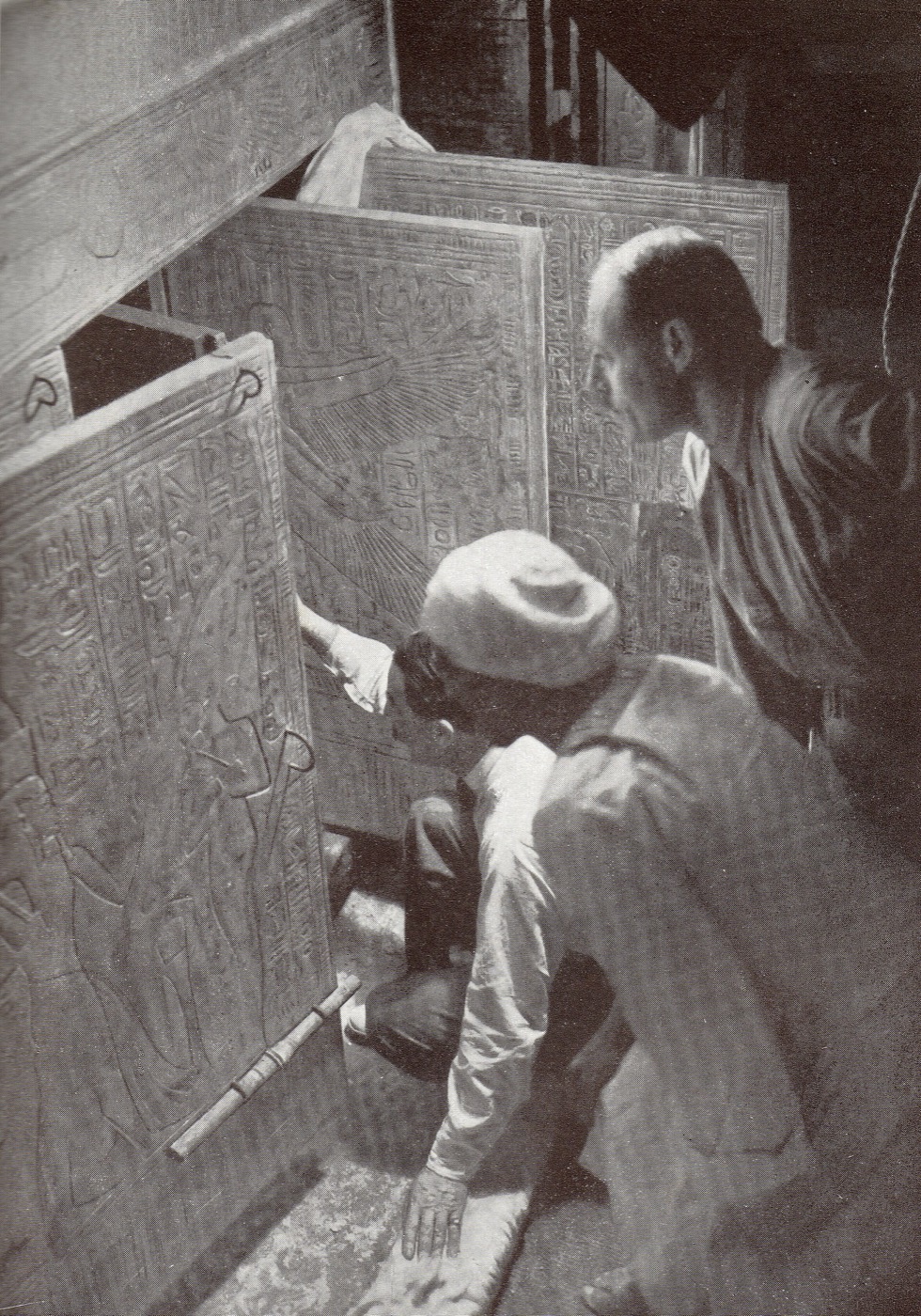
Antoine's leaflet puts it in words of great beauty: it was a striking apparition, in the soft glow of gold, in the shadows barely lit by candlelight, that of the Osiris-king in his prodigious majesty. What a strange sight, the gods of the other world welcoming not the intruders of the 20th century, but the king himself.
The curse
And then, the deaths begin.
The first is Lord Carnarvon himself. In the spring of 1923, just a few months after the tomb was opened, he falls ill in Cairo and dies. Legend has it that at the very moment of his death, all the lights in the city went out. And that in England, at the same instant, his dog howled and died in turn.
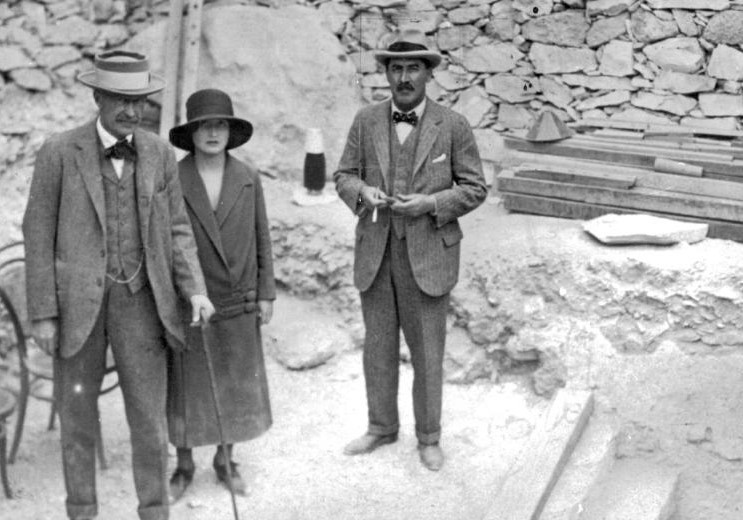
The newspapers seize on the story. All across the Theban plain, people speak in hushed voices of the pharaoh's curse.
Every new death among those close to the expedition makes the front page. Carnarvon's half-brother, Colonel Aubrey Herbert. Howard Carter's secretary. Arthur Mace, the archaeologist who had helped break through the wall of the burial chamber. Archibald Douglas Reid, the radiologist who had X-rayed the mummy. Antoine's leaflet, which draws on the chronicles of the time, lines the names up until your head spins: seventeen scholars in all, carried off by the curse.
How to explain it? The theories of the time are plentiful. Poisons, which the Egyptian priests supposedly left on the stones of the burial chamber and which would have kept their power in Egypt's dry climate. Microscopic fungi, dormant for thousands of years. Some even imagined that the Egyptians knew of substances giving off invisible rays.
But one question, above all, intrigues everyone.
The only survivor
If the tomb was cursed, why was the man who opened it, who spent ten years of his life there, who touched every object, who looked the king in the face, why was he never touched?
Howard Carter lived on for many years after the discovery. He passed away in London in 1939, at sixty-four, of perfectly natural causes. Sixteen years after Carnarvon. Sixteen years of “curse” that never reached him.
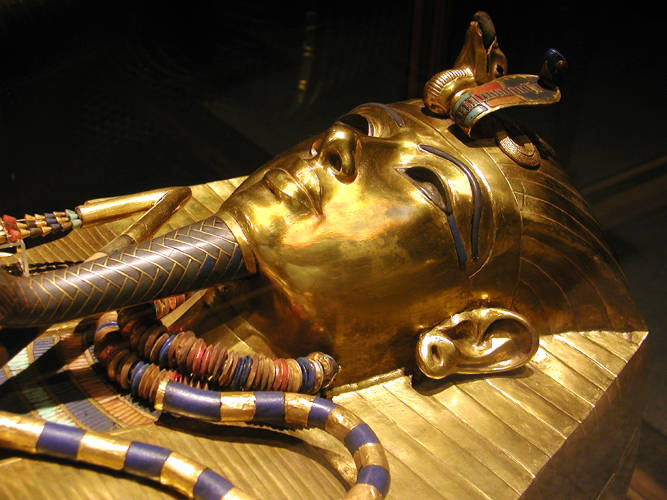
Antoine's old leaflet gives its answer, and gives it plainly:
Legend has it that the Atlantean ring was the secret of Howard Carter, spared by the “curse” of the pyramids.
Leaflet of the Atlantean ring, archives of Antoine de Saint-Christophe

A ring from the Valley of the Kings
So what is this ring?
According to the tradition told in the leaflet, the authentic model was brought back from the Valley of the Kings around 1860 by a French Egyptologist, the Marquis d'Agrain, during his excavations. It is carved in Aswan sandstone, the pinkish-brown stone the Egyptians used to sculpt obelisks and colossal statues. It is said to be several thousand years old.
What strikes you when you look at it is not its material. It is its engravings. Perfectly legible geometric figures, lined up in a precise order: a triangle tipped with a small circle, a series of parallel grooves, a column of small squares, a line that also ends in a circle. The leaflet speaks of an order and an esoteric necessity “beyond dispute”.
The tradition goes further still. It claims the ring was made by the Atlanteans, the legendary people whose heirs the Egyptians are said to have considered themselves. Hence its name. And it tells that a high priest used it as a relay between the pharaohs' priests, keepers of the secrets of a sunken world.
Legend? Of course. But it is a legend that crossed the century, and ended up finding refuge in a castle in Brittany.
The castle of Carivan
The original Atlantean ring is kept by the heirs of Count André de Bélizal, at the castle of Carivan, near Saint-Brieuc, in Brittany.
Bélizal is the father of modern dowsing, the inventor of the famous dowsing pile. It was he who, with Léon Chaumery and then Pierre-André Morel, founded what he called micro-vibrational physics: the study of the invisible forces given off by shapes.
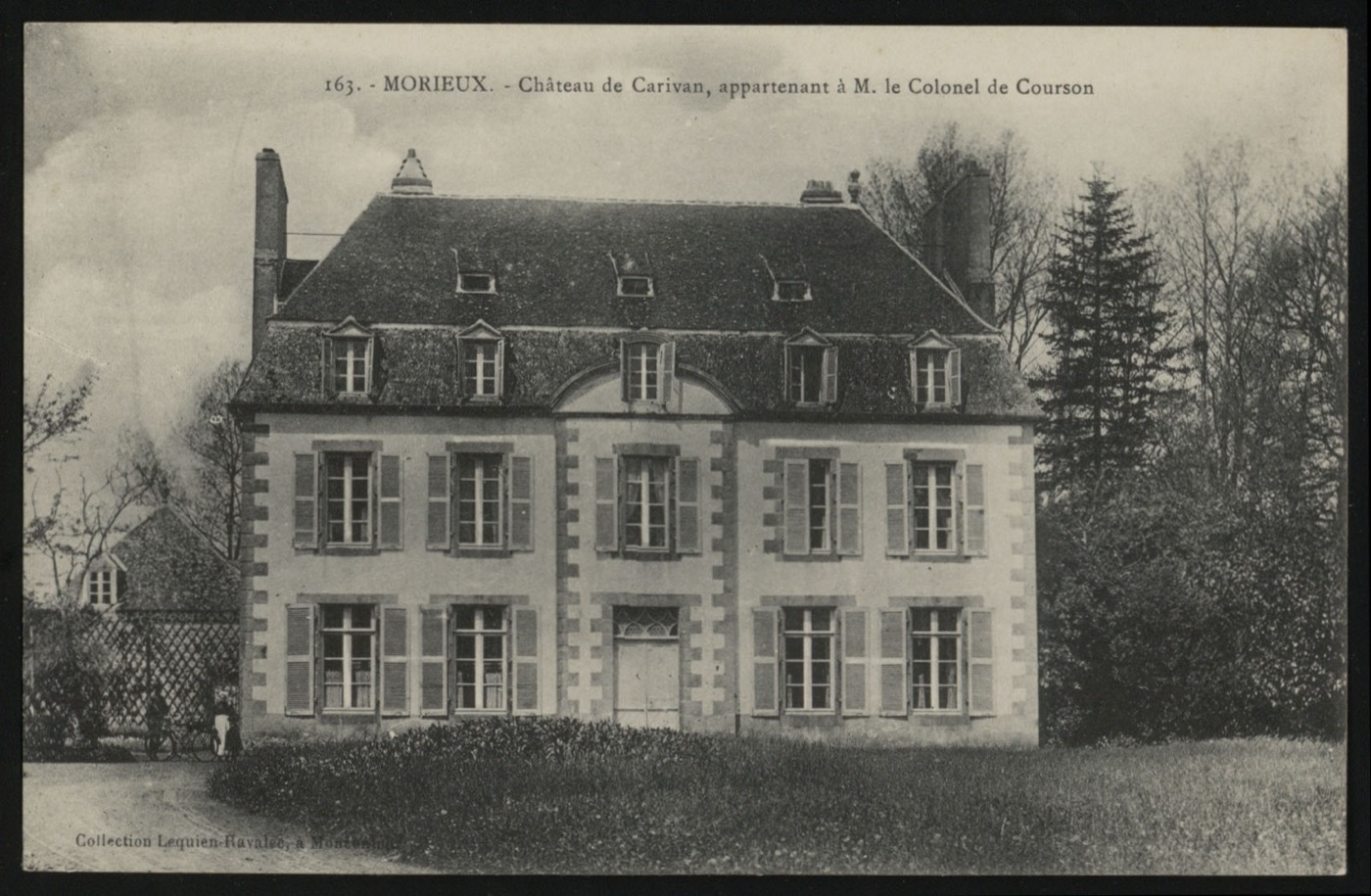
It was at Carivan that the writer Roger de Lafforest, author of Les Lois de la chance (The Laws of Luck), was able to see the ring and touch it. He described it in a landmark book, Ces maisons qui tuent (Houses That Kill). And it was through him that its reputation spread across the French-speaking world.
Antoine summed it up in one phrase: the Atlantean ring is the place and the formula of one of the most astonishing miracles of micro-vibrational physics, in which form effects are the invisible agents.
Neither talisman nor fetish: a shape
This is the most surprising point in the whole story, and the leaflet insists on it strongly.
The Atlantean ring draws its power neither from its material, nor from a magnetic charge, nor from a religious or magical consecration. It is not a personalised pentacle, nor a magnetised talisman, nor a fetish. It has nothing in common with the lucky charms of popular superstition.
Its secret lies elsewhere. It lies in its shape. In the proportions of the band, the angle of the triangle, the spacing of the grooves. This is exactly what Bélizal taught: a precise shape, like a precise antenna, picks up and gives off a precise wave. Change the shape, and you change the wave. That is why, the leaflet says, the making of the ring follows standards that may under no circumstances be changed.
Antoine added an observation drawn from his own work on magic squares: an Atlantean ring without grooves charges too fast and saturates. The grooves act as separators. The structure does everything. He finds exactly the same law in grid magic squares, whose separators prevent saturation.
Read: form waves or form effects?
Otto Brock's ultimate weapon
Of all those who have worn the Atlantean ring, there is one Antoine mentions more than any other: Otto Brock, the legendary master of cosmobiology, the man who never went out without a set of objects nobody else knew about.
Otto Brock praised his Atlantean ring as the ultimate weapon against bad luck.
He was never without another object either: the open phi, developed by his friend Roger de Lafforest. A generator based on the golden ratio: 1.618. The only number in the universe which, multiplied by itself, gives the same result as adding 1 to it. The mathematician Matila Ghyka called it a “cosmic invariant”.
From the meeting of the Atlantean shape and the phi shape came, in 1992, a new generation of generators, the phitrons, developed by the cosmobiologist Hans Heinrich Heckmann and funded by Otto Brock.
Bélizal who keeps it, Lafforest who describes it, Brock who wears it, Antoine who takes up their work in Herstal: the Atlantean ring links all the great names of this story.
What the ring protects
The leaflet describes the ring as a barrier: a dam that neutralises anything that might disturb the vibrational atmosphere, the inner balance of a person. Hostile influences. Bad luck cast by others. Curses and spells of every kind.
To protect the house, Antoine also used lead: the Saint Michael medal, slipped into a black pouch.
The leaflet names three moments to wear it.
For important steps. A decisive meeting, a negotiation, a delicate visit, or a meeting with people whose intentions towards you are not always kind.
When travelling. On the move, and especially when you are driving yourself. The ring's former wearers made it their travelling companion.
At rest. During relaxation or sleep, the leaflet claims the ring sharpens certain subtle qualities, in particular intuition. It even speaks of “escapes into an unsuspected metaphysical realm”.
A ring that becomes yours
There is one rule the leaflet repeats insistently: the Atlantean ring is strictly personal.
Little by little it takes on the waves of the person wearing it. That is why it is not lent, and not given away. You have to get used to its presence gradually, the leaflet says, and learn to live with it. It then becomes your best ally.
Right hand, left hand
The tradition of the ring follows the law of polarity so dear to Antoine:
- by day, on the right hand;
- by night, on the left hand.
Antoine takes up this rule, which he calls the double polarity of introduction, in the instructions for several of his own creations, such as the pendants of the Commodore. There he refers explicitly to “how to use your Atlantean ring”. That shows how much the object served as a model.
The chosen finger
The ring is worn on different fingers, depending on what you are looking for. The leaflet keeps two particular uses:
| Finger | Hand | Use |
|---|---|---|
| Index | Right | Persuading, seeing a negotiation through |
| Middle | Left | Protection from occult influences |
The purification ritual
Before you wear the ring for the first time, the leaflet prescribes a small ritual. Antoine recommended it as it is.
- Burn a stick or a grain of incense.
- Hold the ring in the smoke and trace a cross with it.
- Then make nine circles in the smoke, anticlockwise.
- Finish by tracing a second cross.
This ritual is repeated every six months, so that the ring does not take on foreign imprints.
And one last, very simple instruction: every day, take the ring off for a few seconds, and put it down beside you. Then put it back on. As you would let a living thing breathe.
What the drawing says
Go back to the drawing at the top of this page. It is the one the leaflet reproduced.
A wide, domed band. On its face, a triangle whose tip ends in a small circle. Against it, a column of three small squares, like three stacked stones. Then a series of parallel grooves running around the band. And at the bottom, a line that also ends in a circle.
Nothing decorative. Every line has a function. This is Bélizal's whole lesson, and Antoine's: in the world of shapes, geometry is a language. And the Atlantean ring is one of its oldest sentences.
To go further
The Atlantean ring is the ideal way into the world of shapes. If its story spoke to you, continue with:
- The dowsing pile, Bélizal's other great invention;
- Form waves or form effects, to understand micro-vibrational physics;
- Fortuna Major, the figure of the Great Fortune that Otto Brock engraved on his medals.
The reference books cited in the leaflet (all in French): Roger de Lafforest, Ces maisons qui tuent (Robert Laffont); André de Bélizal and Léon Chaumery, Essai de radiesthésie vibratoire; André de Bélizal and Pierre-André Morel, Physique micro-vibratoire et forces invisibles (Desforges); Albert Champdor, Le Livre des morts des anciens Égyptiens (Albin Michel).
Would you like to know which form of protection we advise for you today? Ask the workshop: we will tell you.
Frequently asked questions
Where does the Atlantean ring come from?
According to the tradition told in its leaflet, the model was brought back from the Valley of the Kings around 1860. The original is kept by the heirs of Count André de Bélizal, at the castle of Carivan, in Brittany.
Where does its power come from?
Not from its material, nor from a magnetic charge, nor from a consecration: only from its shape. It is neither a talisman nor a fetish.
Can I lend my Atlantean ring?
No. Little by little it takes on the waves of the person who wears it: it is strictly personal, it is not lent and not given away.
Does it need purifying?
Before first use, the leaflet prescribes a small incense ritual: a cross traced in the smoke, then nine circles anticlockwise.
Free guide · Luck
Stack the Odds in Your Favor: feel like it always lands on you? A bad patch has a shape, and a calendar to get out of it. Free by email.
Get the free guide →