In Antoine's workshop, a ritual is never done without a material. And of all the ones he used, two come up in his writings more often than any other. He devoted four whole cards to them.
The first is red as blood: the resin of the dragon tree. The second is brown, hard, and gives off a woody smell you don't forget: cade wood.
Part one: dragon's blood
The dragon tree
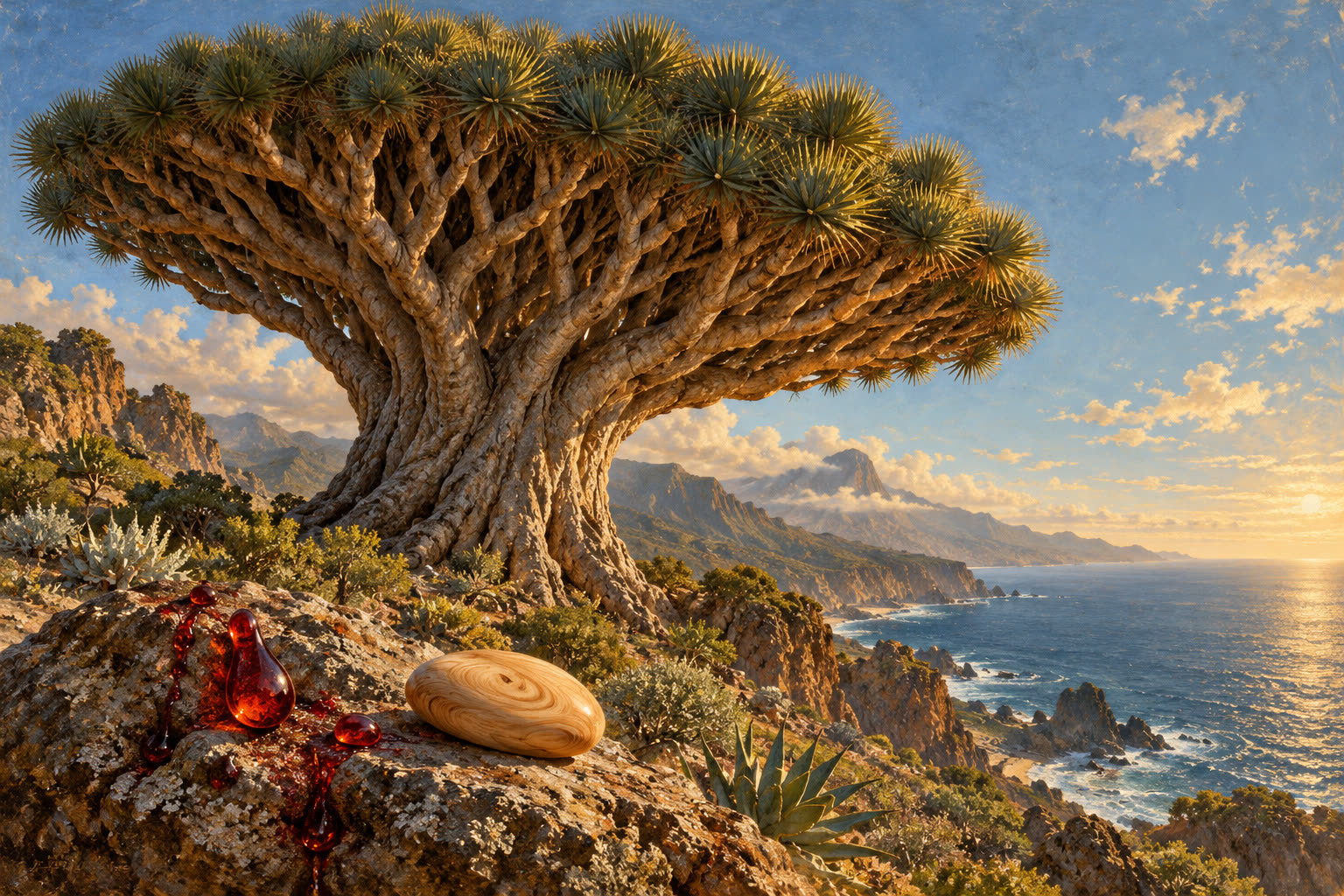
Dragon's blood is the dried sap of the dragon tree, Dracaena draco, a tree-like plant that grows mainly on Madeira, the Canary Islands and Cape Verde.
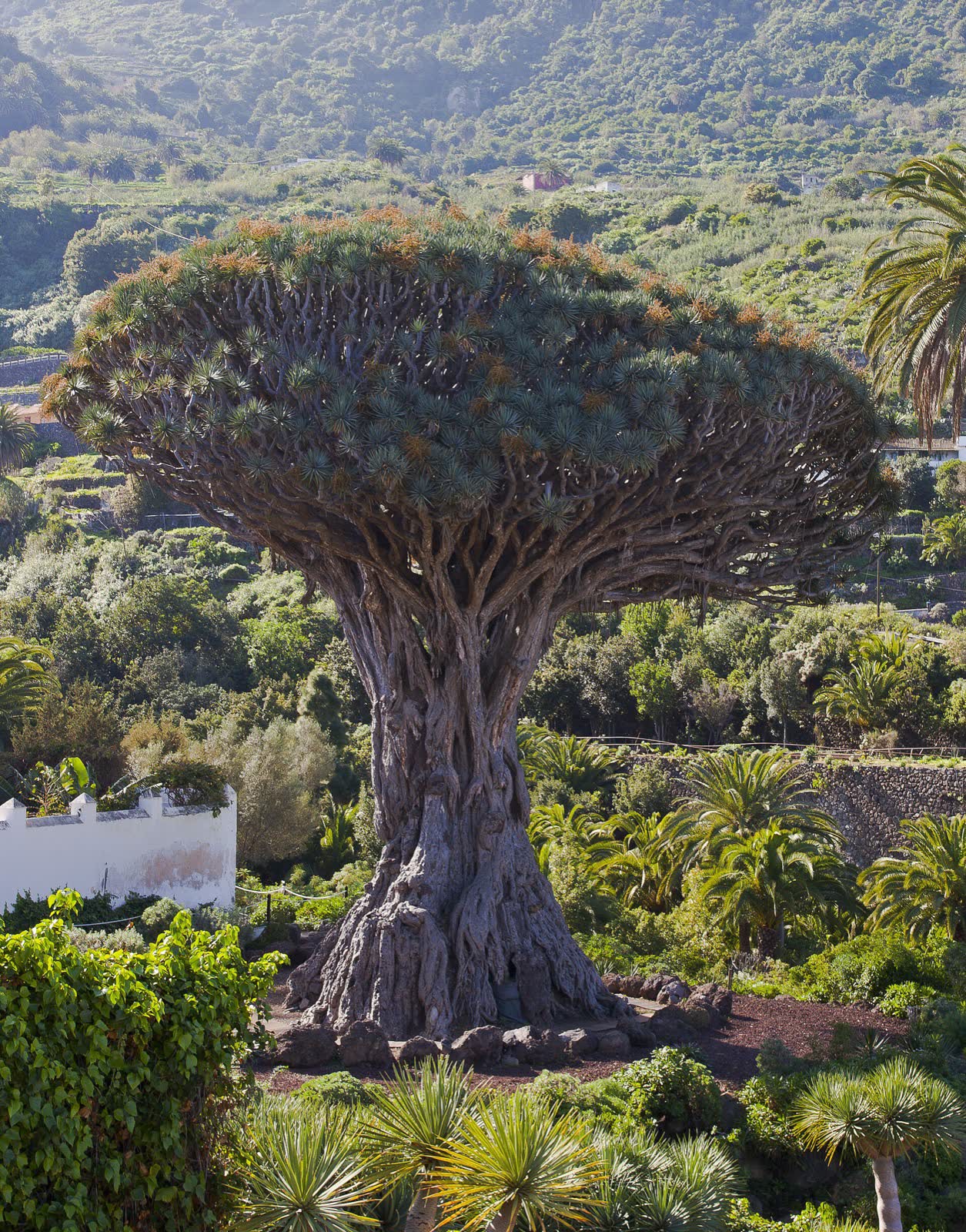
The dragon tree grows extremely slowly. It only flowers, Antoine said, every twenty years. The most famous of them, the thousand-year-old dragon tree of Icod de los Vinos in Tenerife, is one of the oldest trees in the Canaries: it is the one you see at the top of this article.
For Antoine, the presence of a dragon tree drives away evil spirits and draws luck. Its liquid resin is used as a varnish. And its dried resin, dark red, has in his view quite exceptional virtues.
The Guanches, people of the dragon
To explain these virtues, Antoine went back to the history of Tenerife.
Two thousand years before our era, he said, peoples from the mainland settled on the island. They were very tall, had light eyes, and their mystery has often been compared with that of the Atlanteans. They are called the Guanches: from guan, descendant, and Chinech, the name of Tenerife. The sons of Tenerife.
The Guanches mummified their dead with goatskins and dragon's blood, in order to keep a bond with the souls of the departed. They believed in another form of life after death.
They were divided into nine kingdoms, the menceyatos, and lived by fair laws, in tune with the rhythms of nature. Fearsome warriors on land, poor sailors at sea, they fiercely resisted the Spanish conquistadors, who arrived in 1494, for two long years. The objects found from their civilisation show remarkable skill.
An Atlantean secret, without a doubt: the dragon tree and its blood are one of the many riddles of the universe whose principles our ancestors knew.
Antoine de Saint-Christophe
Antoine added a rule drawn from this tradition: if you burn goat hair and pass an object charged with bad influences through its smoke, the object is instantly purified.
Planting a dragon tree
Antoine advised growing one. And he gave the method.
- Sow a seed of the Canary Islands dragon tree (Dracaena draco) 1 to 2 centimetres deep in a small pot of soil, at a temperature above 8 °C (46 °F).
- Repot it into a large pot seventy-five days later.
- Sow preferably in May, June, July or September in a continental climate, and from April to September in a Mediterranean climate.
- Sow while the Moon is rising, and slip a few obsidians into the soil: in his experience, they speed up and strengthen growth.
What the dragon tree brings
Placed in front of a shop or indoors, the dragon tree, Antoine wrote, keeps bringing in new customers and draws prosperity. It keeps ill-intentioned people away and brings new and solid friendships.
That is why, he noted, most of the big hotels in the Canary Islands have a dragon tree at their entrance.
The dragon's blood fumigation
Here is the rite of the resin, as Antoine described it. It is for external use only: dragon's blood is never eaten or drunk.
- Take an ordinary censer.
- Light a 33-millimetre quick-lighting charcoal disc and place it in the censer.
- As soon as a grey ring appears on the charcoal, put three grams of dragon's blood on it.
- Hold the hand you write with in the smoke for three minutes, high enough above the ember not to burn yourself.
Safety. A glowing charcoal disc is very hot: handle it with tongs, on a heat-proof surface, in a ventilated room, away from children and pets, and never leave it unattended.
What dragon's blood brings
Antoine listed its properties as the tradition gives them:
- a powerful love philtre;
- a very great protective power, pushing back the negative vibrations of the living and the dead;
- communication with your guardian angel and with loved ones who have passed away;
- peace and happiness in the home;
- quiet in a noisy house, where the furniture creaks and objects seem to move;
- the famous “brazen luck” occultists talk about;
- the favour of an anonymous third party: an exam, an administrative decision, a benefit claim.
And a charming tradition: if the fumigation takes place in a room with the window open, and the smoke leaves the room, the young woman of the house will marry within the year.
Antoine also combined dragon's blood with mandrake for the sale of certain objects. Families in the Geer valley, he said, had practised this fumigation for generations. Read: the ossuary of Boirs.
Part two: cade wood
“Miraculous”
In Provençal, Antoine wrote, cade means miraculous.
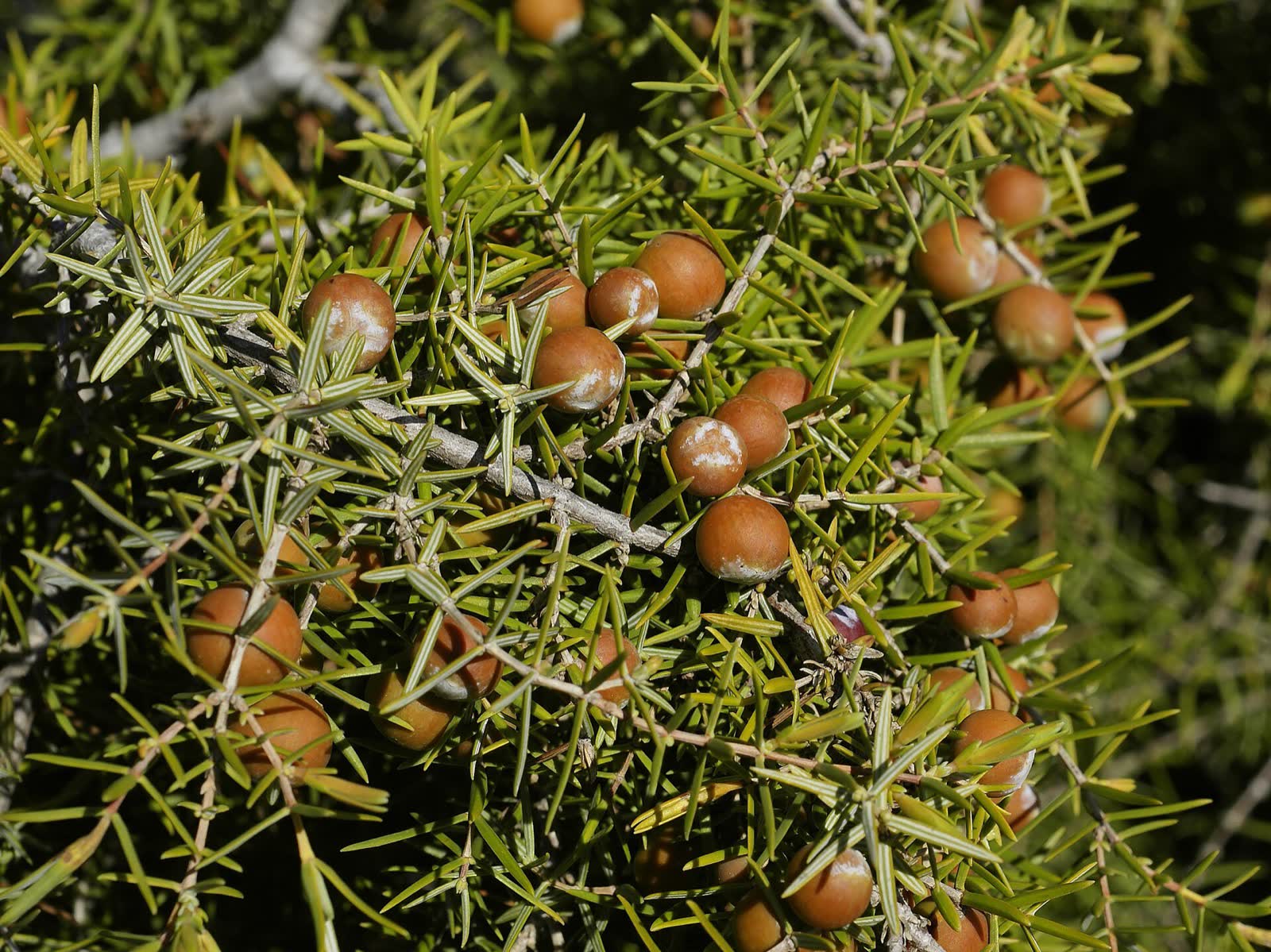
Cade is a species of juniper: Juniperus oxycedrus, the prickly juniper. You can recognise it by two white stripes on its needles, whereas common juniper, the one that flavours gin, has only one. Its wood is very dense and very hard. Its scent is woody, masculine, timeless, and it soaks deeply into everything it touches.
And cade has character. It is always found scattered, in inaccessible places, on the scrubland and dry hillsides of southern France, and above all in Cathar country. You will never see a cade plantation: it cannot be cultivated. It is a wood that refuses to be “tamed”, and it doesn't like the company of other trees.
A wood steeped in history
Antoine had gathered an astonishing collection of stories around cade.
- The Egyptians put cade wood in their jars to keep water perfectly pure, and burned it inside their pyramids to thank and question the oracles.
- The Templars claimed that the scent of cade at daybreak granted immortality. Many guesthouses around Limoux still have a cross of Templar origin made of cade wood.
- Napoleon, it was said, ordered his army's uniforms dyed with the red berries of cade, under the seal of secrecy.
- It was forbidden to burn cade in the old courts of law.
- And the expression “touch wood”, according to Antoine, may come from the use of cade.
The most powerful repellent
Antoine first presented cade as the most powerful natural repellent he knew. Its fumigations freshen the atmosphere, absorb bad smells, especially tobacco and frying, and keep away moths, flies, wasps, mosquitoes and rodents. For him it was also a true neutraliser of harmful waves, acting on most of the geomagnetic disturbances in the ground.
But it was above all its occult powers that interested him. The sacred wood, he said, drives away bad luck in general, and radically breaks feelings of hatred, possessiveness and jealousy.
Cade combinations
Cade, Antoine wrote, changes power depending on what it is combined with:
| Combined with… | Cade… |
|---|---|
| Vervain | draws love relationships |
| Sulphur and iron | draws luck in money matters |
| Storax | calms the evenings, invites the quiet of the night and neutralises spite |
| Form waves | strengthens form effects |
He warned against combining it with fern, which is very strongly polarised: male fern attracts women, female fern attracts men. Better, he advised, to use vervain, which is safer.
The terracotta pyramid
Antoine told the story of a mage in Agadir who, according to the story, had helped many people with his desert cross, his cowrie shells and his cade fumigations through a terracotta pyramid. This shape, fumigated with cade or carved from cade wood, draws smiles and sympathy, and mends lost family ties.
And cade fumigated through a pyramid with the proportions of Khufu (Cheops) would, in his view, lift the old spells weighing on a family or a house.
Cadaliths: cade pebbles
At the great fetish market of Lomé, Antoine said, you can see terracotta basins filled with pebbles of cade wood, worn and polished like river stones. The marabouts invite passers-by to touch them, for happiness. Antoine called them cadaliths.
A cade pebble rubbed on clothing warms up and gives off a very soothing scent. Placed for a moment on the bonnet or roof of a car, it protects it on the road, he said. And for Antoine, the patterns of its grain have supernatural properties.
Here is one of his favourite rites:
To bring happiness to someone, or to yourself: stack a number of cade pebbles equal to the person's age, for example 46 pebbles for 46 years, place them in a terracotta basin, and set it in full light.
The sigil magic of cade
Antoine devoted a whole card to what he called, after a treatise by Viscount René de Margel, the sigil magic of cade. Its principle fits in one sentence:
What is carved on cade comes true.
After Viscount René de Margel
A sigil is an energetic figure, a message condensed into a single sign. Here is how Antoine taught people to create one.
- Write your wish in your own language. Antoine's example, in French: “J'AVANCE AVEC CONFIANCE” (“I move forward with confidence”).
- Remove the repeated letters: what remains is JAVNCEOFI.
- Remove the vowels: what remains is JVNCF.
- Place these letters on a sigil rose, such as the Golden Dawn's, and join them with straight lines in order: J to V, V to N, N to C, C to F. The figure you get is your sigil.
- Carve it into a cade pebble with the point of a knife. Carved into cade, a sigil is instantly activated.
The rules:
- a sigil is drawn on one side only, never front and back;
- one sigil per support;
- a sigil is strictly personal;
- it is much more powerful when the person carves it themselves. If someone else makes it, the owner should do a cade wood fumigation before wearing it.
Antoine mentioned several alphabets used for sigils: runes, Hebrew, the angelic alphabet, Theban, Enochian, geomantic figures. Viscount de Margel recommended ogham to French speakers, the script of the ancient Celts, in perfect resonance with cade.
It is so easy that you might find it hard to believe it really works. Try it. The only thing you have to lose is your doubt.
A quotation Antoine liked to repeat
The phrase of a thousand powers
And finally there is the phrase that Viscount René de Margel always carried with him, carved on a cade pebble. Antoine recommended it without reservation, to carve yourself with a knife and carry on a key ring:
ABA ALNY ABAFROY AZERA PROCHA
“Known since the dawn of time,” he wrote, “cade speeds up the process by which this phrase of a thousand powers comes true.”
The macralles and cade
Antoine couldn't talk about cade without telling a story from his own region. Cade wood and witches, he said, don't get on.
In the Basse-Meuse, the “macralles”, witches in Walloon, do everything they can to stop cade wood being sold. In the Geer valley, in Boirs, Eben-Emael, Haccourt, and in the Croix-Jurlet district of Herstal, certain young women who catch the smell of cade will lead you off to drink “di neûr pèkèt des macralles”, juniper gin with blackcurrant, to “bewitch” you for good. And around Vielsalm and Nadrin, they'll have you drink “pihot de macralle”, a blueberry liqueur, to enchant you for the rest of your days.
How do you recognise them? Young macralles, Antoine noted, like to dress in red and black, and their little high-pitched laughs always give them away.
At home
Antoine ended with the simplest of advice.
- Keep your cade in the open air, for example in a small, wide cade-wood bowl, in your living room or bedroom.
- Fumigate half a teaspoon of cade powder on a glowing ember, in each room of the house, with the same care as for any ember.
And see the benefits of cade wood for yourself.
Antoine de Saint-Christophe
Looking for genuine dragon's blood, cade pebbles or powder for your fumigations? Write to the workshop.
Photos: Diego Delso (CC BY-SA 3.0) and Hans Hillewaert (CC BY-SA 4.0), via Wikimedia Commons.
Frequently asked questions
What is dragon's blood?
The dried sap of the dragon tree, Dracaena draco, which grows mainly on Madeira, the Canary Islands and Cape Verde. It is for external use only.
What does “cade” mean?
In Provençal, Antoine wrote, cade means “miraculous”.
How do I use cade at home?
Keep it in the open air, in a small cade-wood bowl, and fumigate half a teaspoon of powder on a glowing ember, as Antoine describes in the article, in a ventilated room and never unattended.

Free guide · Alchimixe GPS
Stack the Odds in Your Favor
Feel like it always lands on you? A bad patch has a shape, and a calendar to get out of it.
Get the free guide